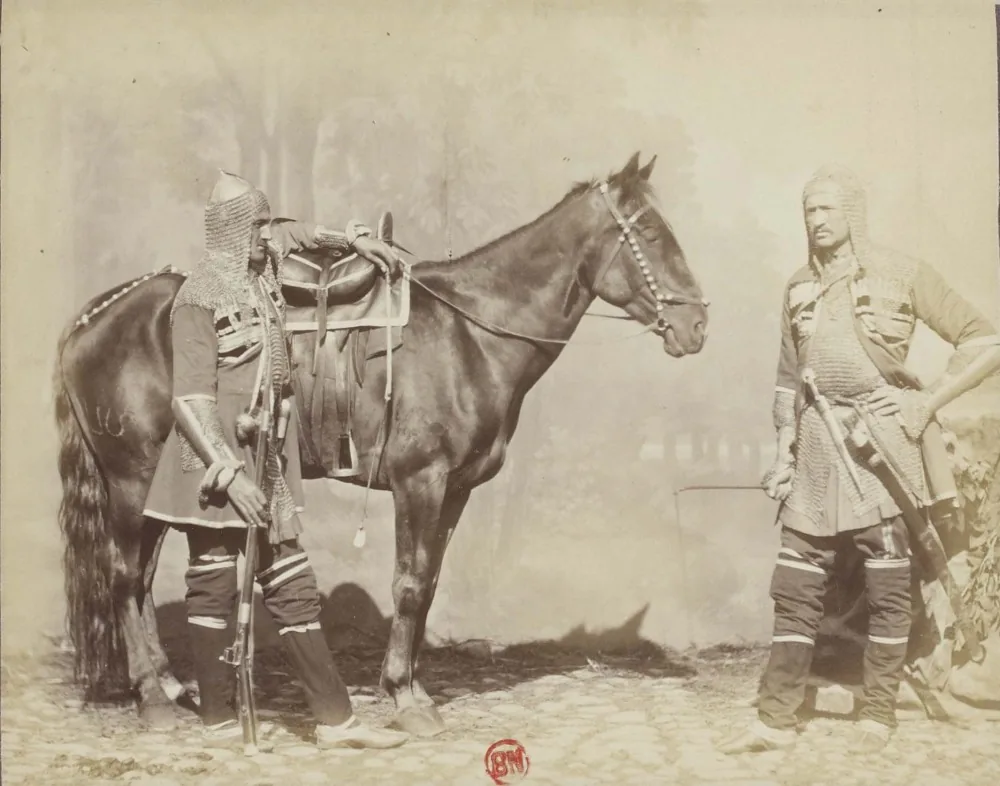
The Circassian warrior tradition was above all a code of honour. Its knightly form, Worq Khabze, asked for riding skill, endurance and emotional restraint, and it was a disgrace to attack an unarmed person or strike from behind. Boys were trained from childhood in riding and arms; the shashka sword takes its name from a Circassian word; and Circassian-born sultans ruled Egypt from 1382 to 1517. Today the tradition lives on in Habze, in dance and in words like лIыгъэ, courage, and напэ, honour.
The Circassian warrior tradition is one of the best-known sides of Adyghe culture. But the warrior ideal was never only about fighting. It belonged to Habze, the Circassian code of conduct: a true warrior was measured by his restraint, his generosity and his honour as much as by his skill.
Training and weapons
Training began in childhood. In the Atalyk system, noble and well-off families sent their sons to be raised by experienced tutors, who taught them to ride, to handle weapons and to speak politely. Endurance mattered as much as skill: hunger, thirst, cold and heat, nights in the open and icy rivers crossed without stopping.
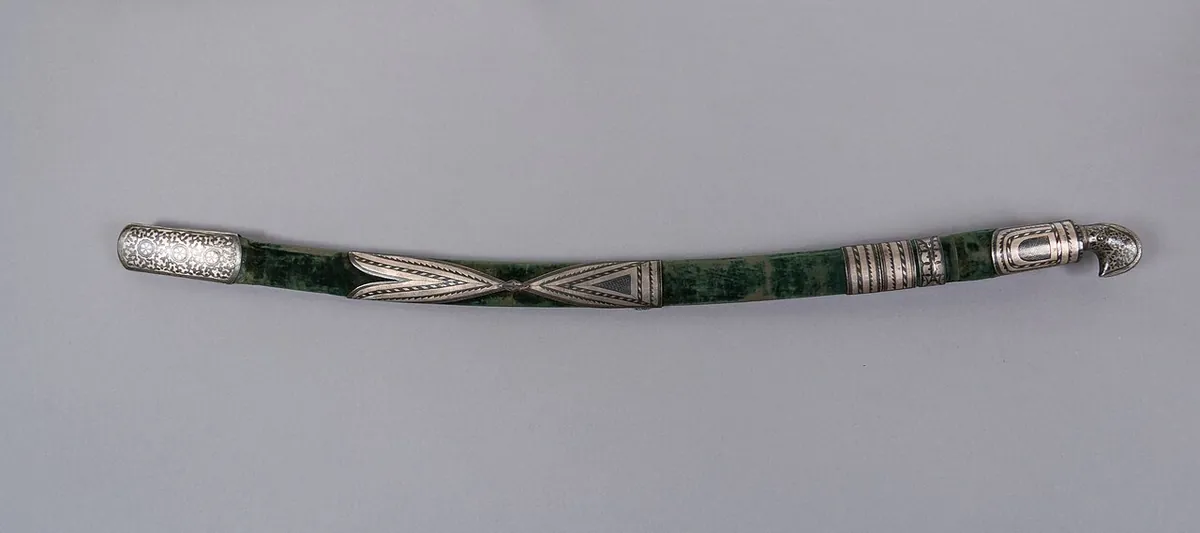
Carrying arms was a sign of a free man’s honour. A man took off his qama, the long dagger, only when he took off his coat, and every man, from shepherd to prince, owned a sword and a rifle. The sword was the shashka, a single-edged, one-handed blade with a gentle curve and no guard, worn edge up. Its name comes from the Circassian сэшхуэ, “long knife”, and in 1834 the Russian army adopted it in its first military pattern; over the century it replaced the sabre in all Russian cavalry except the hussars. The kama (къамэ), the double-edged dagger, was even part of the dance. More in the Circassian shashka and kama and, for the cherkeska with its cartridge holders, Circassian clothing.
The Kabardian cavalry
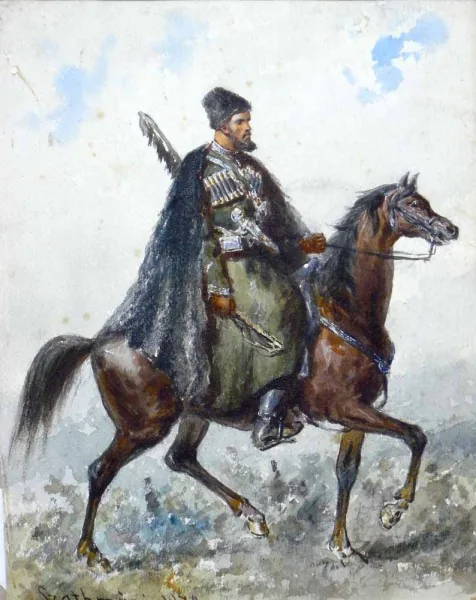
The rider and his horse were inseparable. The Kabardian horse has been known for at least 400 years, bred by Circassians, above all the Kabardians, since the 16th century for stony mountain paths and long journeys; it is known for its hard hooves and has been called the best mountain horse. Worq Khabze put riding skill at the heart of a nobleman’s training.
Warriors and Habze
Worq Khabze was the code of the nobility and the knightly class, and over time its standards spread to everyone and became part of Habze itself. Its rules were strict:
- Honour before life. Life was worth living only with honour; the moral models were the heroes of the Nart sagas.
- No dishonourable blow. Attacking an unarmed person, striking an opponent from behind or killing a sleeping enemy was a disgrace and a sign of cowardice.
- Restraint. A warrior hid his pain and his feelings; boasting about one’s own bravery was frowned upon.
- Generosity. A man rose in standing by giving away what he had won, not by keeping it.
ЛIыгъэр ажалым щыщтэркъым.
Courage is not afraid of death. (Kabardian proverb) · more proverbs
Fame came through song. Poets and singers made songs to honour the brave, and a place in a heroic song was the surest way to be remembered, but the singers, the djeguako, were bound by Habze too: a song could not falsely praise a hero or belittle an opponent (Circassian music).
Circassian warriors abroad
The most remarkable chapter abroad is Egypt. From 1382 to 1517 the Mamluk sultans were mostly Circassian-born: Barquq, the first, took the throne in 1382, and Barsbay and Qaitbay, a famous archer and horseman, followed him. They are remembered above all as builders: Barquq’s complex on al-Mu’izz street in Cairo, Qaitbay’s citadel in Alexandria on the site of the ancient Lighthouse, and Qaitbay’s funerary complex, the building on Egypt’s one-pound note. Read the whole story in the Circassian Mamluks.
In the Ottoman Empire, Circassians rose to the highest offices: Çerkes Mehmed Pasha, “Mehmed Pasha the Circassian”, was grand vizier in 1624–1625. And in Jordan, the king’s Circassian Bodyguard still serves in the royal palaces (Circassians in Jordan).
The legacy today
The warrior tradition lives on in values: discipline, restraint, honour and loyalty, all part of Habze. It lives on in Circassian dance, where movements still mimic dodging a sword stroke, the gait of a horse or the flight of an eagle. And it lives on in play: the Circassian games in the app include a sword duel won through Habze and an archery duel won with Circassian words.
Above all it lives on in the language. The words of the tradition, from the app’s lessons, in both dialects:
| Meaning | Kabardian | Adyghe |
|---|---|---|
| warrior | зауэлIzawel' | заолIzaol' |
| sword | джатэdzhate | чатэchate |
| courage | лIыгъэl'yghe | лIыгъэl'əghe |
| honour | напэnape | напэnape |
| hero | лIыхъужьl'ykhuzh' | – |
| horse riding | шыгъажэshyghazhe | шыгъачъэshəghache |
| Circassian coat | цейtsey | цыеtsəye |
The Circassian App teaches them in its Kabardian and Adyghe courses, and its Habze course has a unit of four lessons on the warrior code. More famous Circassians in famous Circassians in history.
Free on iPhone & Android
Circassian language and culture, in one app
Kabardian and Adyghe lessons, Habze culture lessons, a library of books, films and music, and Circassians from around the world to talk to.

4.9 on the App Store 53,000+ people in 100+ countries
The Circassian warrior tradition: questions
What is Worq Khabze?
The code of conduct of the Circassian nobility and knightly class: riding skill, prowess and emotional restraint. Over time its standards became part of Habze for everyone.
What weapons did Circassian warriors carry?
The shashka, a single-edged guardless sword whose name comes from the Circassian “long knife”; the qama or kama, a double-edged dagger; and later a rifle.
Where does the word shashka come from?
From the Circassian сэшхуэ, “long knife”. The Russian army adopted the sword in 1834.
Were the Mamluk sultans Circassian?
From 1382 to 1517 most of them were Circassian-born, among them Barquq, Barsbay and Qaitbay.
How do you say “courage” and “honour” in Circassian?
Courage is лIыгъэ and honour is напэ, in both Kabardian and Adyghe.
Sources
- Wikipedia (English), “Adyghe Khabze”. en.wikipedia.org/wiki/Adyghe_Khabze
- Wikipedia (English), “Çerkes Mehmed Pasha”. en.wikipedia.org/wiki/Çerkes_Mehmed_Pasha
- The sources of the site’s pages on the shashka and kama, the Kabardian horse, the Circassian Mamluks, Circassians in Jordan, Circassian dance.
- Proverb: the Kabardian Wikipedia list and the Kabardian-Circassian-Russian dictionary (Apazhev, Kokov, 2008), p. 312, as on Circassian proverbs.
- The Circassian App: lesson vocabulary (Kabardian and Adyghe) and the Habze course unit “Warrior Code”.
Want more like this?
The app has 64 short lessons on Circassian traditions, including four on the warrior code. Plus a course in Kabardian or Adyghe to learn the language behind them.
Download free53,000+ people in 100+ countries
