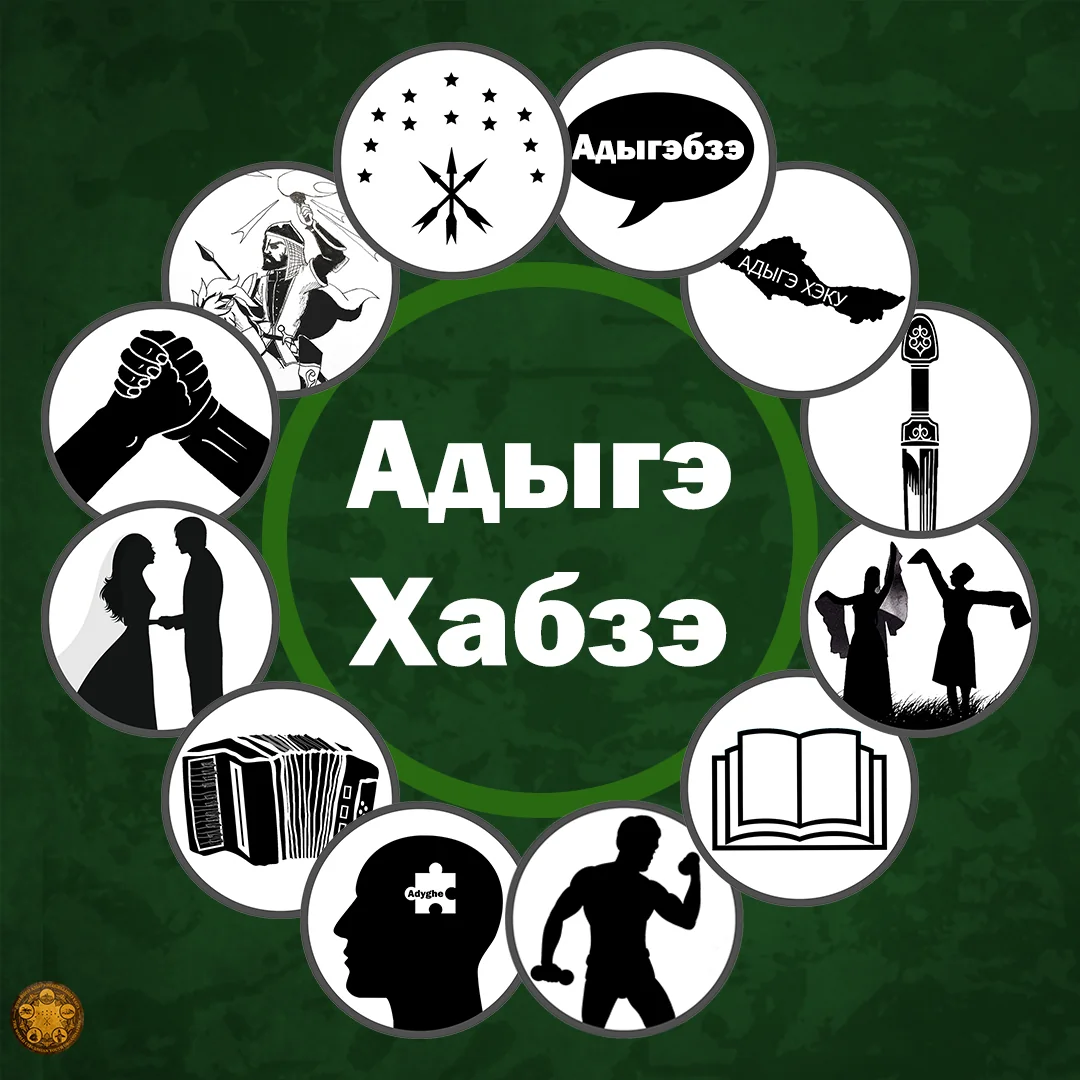
Habze (Адыгэ Хабзэ, Adyghe Khabze) is the traditional moral code and etiquette of the Circassians. The word хабзэ means law, custom and tradition. Never written down, it once served as the unwritten constitution of Circassia, and it still shapes how Circassians treat elders, women and guests, how they speak and how they behave in company. It is not a religion: it is older than Islam among the Circassians and lives alongside it.
Ask Circassians what holds their culture together and many will answer with one word: Habze. It is the set of principles that governs everything from how to greet a stranger to how to seat a table, and it has done so for centuries. It is not a religion and it is not a written law. It is the Circassian way of behaving.
What does Habze mean?
Хабзэ (also spelled Xabze or Khabze) means law, custom and tradition, and the Kabardian dictionary defines Адыгэ Хабзэ as the whole body of unwritten laws, customs and traditions kept for centuries. One explanation of the word reads it as “the language of society”. Habze covered three kinds of rules: everyday etiquette, the ceremonies of life (weddings, funerals, the birth of a child, feasts), and legal norms on land, inheritance and duties, which councils enforced.
Its starting point is that the individual is for the society: a person always acts as a representative of their family and lineage, and is judged by how well they keep Habze. It applied to everyone, princes included.
Hear the words in both dialects, from lesson 29 of the audio course:
| Meaning | Kabardian | Adyghe |
|---|---|---|
| custom, tradition | хабзэkhabze | хабзэkhabze |
| Circassian custom | Адыгэ хабзэ.Adyge khabze. | Адыгэ хабзэ.Adyge khabze. |
| Circassian custom is precious. | Адыгэ хабзэр лъапIэщ.Adyge khabzer lhap'eshch. | Адыгэ хабзэр лъапIэ.Adyge khabzer lhap'e. |
| respect, decency | нэмысnemys | нэмысnemys |
| the elder who leads the table | тхьэмадэthemade | тхьаматэthamate |
The core principles of Adyghe Habze
Behind Habze stands Adyghaghe, roughly “Circassianity”: the moral ideal a person reaches by living by Habze. It rests on five pillars: humanity, dignity, reason, courage and honour. The Kabardian dictionary has the words for three of them: нэмыс (decency, respect, honour), акъыл (mind, reason) and напэ (face, and also conscience). A Circassian saying warns that if Adyghaghe disappears, the Circassians will disappear.
Нэмыс здэщымыIэм насыпи щыIэкъым.
Where there is no modesty, there is no happiness either. (Kabardian proverb) · more proverbs
In practice, Habze teaches:
- Respect for elders. A younger person stands when an elder enters, does not sit without permission, does not interrupt, and steps back rather than turn their back when leaving. Walking together, the elder is on the right. Every gathering has its thamate (Kabardian тхьэмадэ, Adyghe тхьаматэ), an elder chosen for knowledge and reputation. The Kabardian for “elder” is нэхъыжь.
- Respect for women. Men stand when a woman approaches and give her the right of way; a rider dismounts and stands aside until she has passed, and coarse language is forbidden in front of women. A woman could stop a fight by dropping her handkerchief between the two sides, and anyone pursued was safe in the company of women.
- Hospitality. A guest is “a messenger from God”, served the best before any questions and protected by the host: see Circassian hospitality.
- Kind words, no boasting. Speaking clearly and kindly is a sign of character; too much talk, sarcasm and boasting about one’s own bravery or success are frowned upon. People stand when a guest or an elder enters.
- Charity without reward. Псапэ, a good deed, must be done without expecting thanks or anything in return.
- Loyalty. Faithfulness to friends and to one’s given word, protection of the weak against the strong and defence of the homeland are among its teachings.
How Habze governed
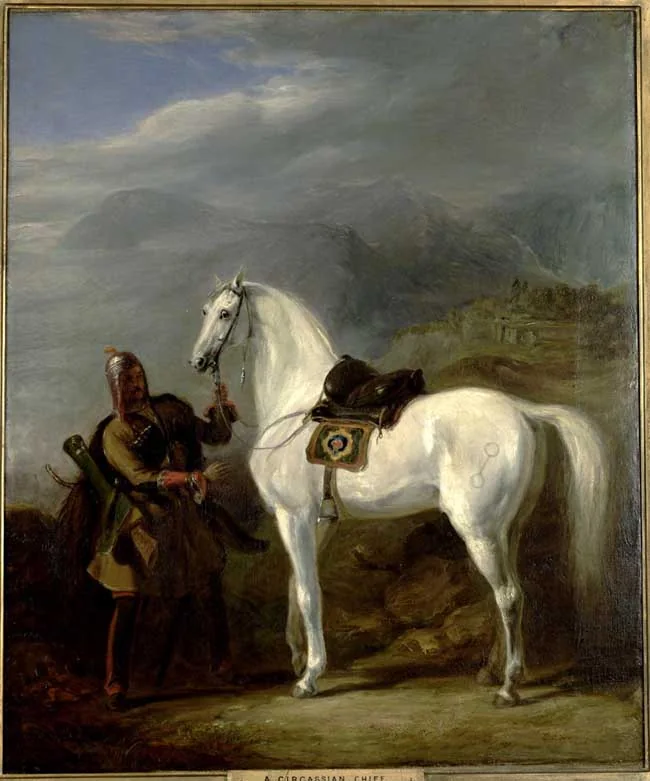
Historically, Habze was the unwritten constitution of Circassia, covering legal disputes, conflict resolution, military affairs and government. Its rules were set and changed by the khase, the assembly, which gathered representatives from every region and decided by unanimous consensus. Princes were not supposed to rule as despots: they could not take decisions that bypassed Habze, and true authority lay in the decisions of the people and the elders they chose.
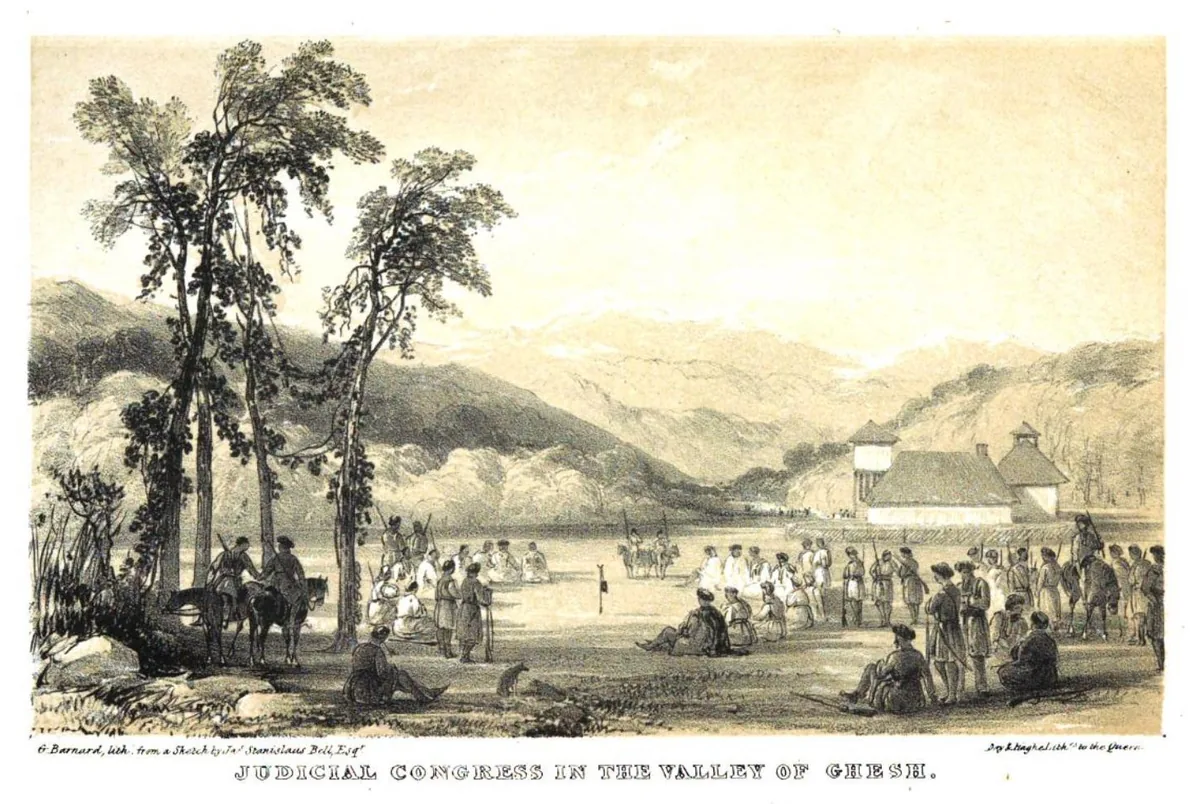
Habze was meant to be flexible. In the 18th century the thamate Jabagh Qazanoqo, credited with a major reform, defined Habze as “that which is appropriate”: he curbed the princes’ power over free peasants, argued for more rights for women, introduced a ritual of reconciliation to end blood feuds and brought Habze into line with Sunni Islam. In the diaspora the khase lived on as Circassian associations, founded in Jordan in 1932, Syria in 1948, the United States in 1952 and Turkey in 1961, which today run charity, culture and youth programmes.
Habze and nature
Habze set rules for the land as well. For every tree cut down, three new ones had to be planted, and whoever built a house had to plant trees. When fruit and nuts were gathered, at least a third was left on the branches for animals and birds, and rivers and streams, the arteries of the earth, had to be kept clean. Hunting was allowed only from October to February, never of females or young animals, and never more than the hunter needed.
Habze in daily life
Habze is not a museum piece. Modern life has simplified it, and Circassians speak of an Old Habze and a New Habze, but the spirit is kept. Today it is lived mainly through everyday etiquette, Habze gatherings, respect for elders and for the opposite sex, weddings, the seating order at gatherings and funeral customs. Education has become part of it too: it now counts toward a person’s standing alongside good manners.
Most Circassians still hold to it. In a five-year study of 2,500 people in Adygea, Kabardino-Balkaria, Karachay-Cherkessia, Krasnodar Krai, Moscow, St Petersburg and Istanbul, 97% of those who identify as Circassian said they try to follow Habze at least to some extent; 20% said they follow it constantly, and only 3% said they are practically not guided by it. In some schools in the Caucasus, Habze is taught as a subject.
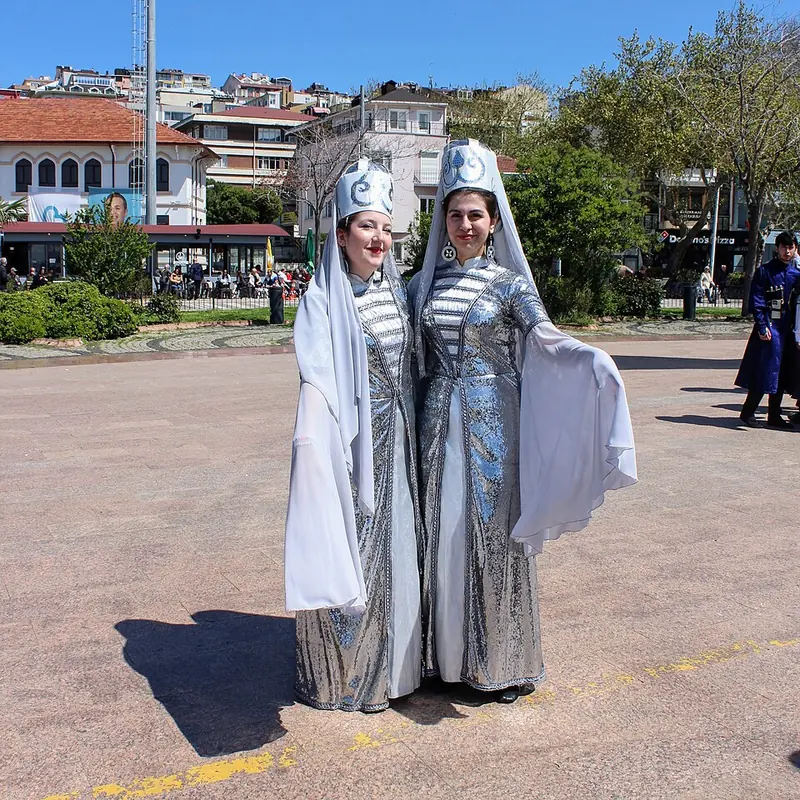
The hardest part is passing it on to children who grow up far from the Caucasus, often without the language. Families do most of that work: see how Circassian families keep the language alive and Circassian table etiquette.
Habze and Islam
Habze is not a religion. It is older than Christianity and Islam among the Circassians, with roots in the Nart sagas, and it lived alongside Christianity and now lives alongside Islam. Each faith reinforced it: following Habze became the duty of a good Christian, and later of a good Muslim, and the old Circassian word for God, Тхьэ, came to mean the God of the Abrahamic faiths. Traditional Hanafi Sunni Islam in Circassia left room for Habze to govern community life, and those who joined both were seen as the cultured, pious elite. A Circassian creed sums it up: “The Creator is in heaven, and the Adyghaghe granted by Him is on earth.”
Habze and Circassian dance
Habze reaches into music and dance as well. Young men and women met at dance parties, the djegu, where Habze set the rules of how they behaved toward each other. The singers and poets, the djeguako, were the guardians of Habze: a song could not falsely praise a hero or belittle the courage of an opponent, and doing so was a disgrace. Read more in Circassian dance, Wuj, Qafa, Islamey and Circassian music.
Habze in 16 units
The Habze course in the Circassian App shows how much ground Habze covers. It has 16 units of four lessons each, in English, Russian, Turkish or Arabic:
- Core Values
- Hospitality
- Warrior Code
- Respect & Family
- Proverbs & Wisdom
- Nart Mythology
- Marriage & Wedding
- Music & Dance
- Traditional Dress
- Cuisine & Table
- Democratic Council
- Horse Culture
- Craftsmanship
- Nature & Sacred Places
- Circassian Tribes
- Festivals & Traditions
Why Habze matters now
For the Circassian diaspora, Habze is not only history. It is a guide to living with dignity and staying connected to a community spread across many countries (the Circassian diaspora today).
Learning Habze goes hand in hand with learning the language: its key ideas, нэмыс, напэ, хабзэ itself, are words first. The Circassian App teaches Kabardian and Adyghe alongside its Habze course. Start with how to learn Circassian.
Free on iPhone & Android
Circassian language and culture, in one app
Kabardian and Adyghe lessons, Habze culture lessons, a library of books, films and music, and Circassians from around the world to talk to.

4.9 on the App Store 53,000+ people in 100+ countries
Habze: questions
What does Habze mean?
Хабзэ means law, custom and tradition. Адыгэ Хабзэ is the whole body of unwritten Circassian laws, customs and traditions, often called the Circassian code of honour.
Is Habze a religion?
No. It is a moral code and etiquette, older than Christianity and Islam among the Circassians. Today it lives alongside Islam, and following it was long seen as part of being a good Muslim.
What is Adyghaghe?
Adyghaghe, roughly “Circassianity”, is the moral ideal a person reaches by living by Habze. It rests on five pillars: humanity, dignity, reason, courage and honour.
What are the main rules of Habze?
Respect for elders and for women, hospitality, kind words and no boasting, charity without expecting a reward, and loyalty to friends and to one’s word.
Do Circassians still follow Habze?
Most do: in a study of 2,500 people, 97% of Circassians said they try to follow it at least to some extent, and 20% said they follow it constantly.
Where can I learn about Habze?
The Circassian App has a Habze course of 16 units, four lessons each, in English, Russian, Turkish or Arabic, next to its Kabardian and Adyghe lessons.
Sources
- Wikipedia (English), “Adyghe Khabze”. en.wikipedia.org/wiki/Adyghe_Khabze
- Apazhev M. L., Kokov J. N. Kabardian-Circassian-Russian dictionary. Nalchik: Elbrus, 2008, pp. 22, 333, 336, 338, 364, 474.
- Wikipedia (Kabardian), “Адыгэ Псалъэжьхэр” (Circassian proverbs). kbd.wikipedia.org/wiki/Адыгэ_Псалъэжьхэр
- The Circassian App: audio course lesson 29 (Kabardian and Adyghe) and the 16 units of the Habze course.
Want more like this?
The app has 64 short lessons on Habze, from hospitality and respect for elders to weddings and dress. Plus a course in Kabardian or Adyghe.
Download free53,000+ people in 100+ countries
