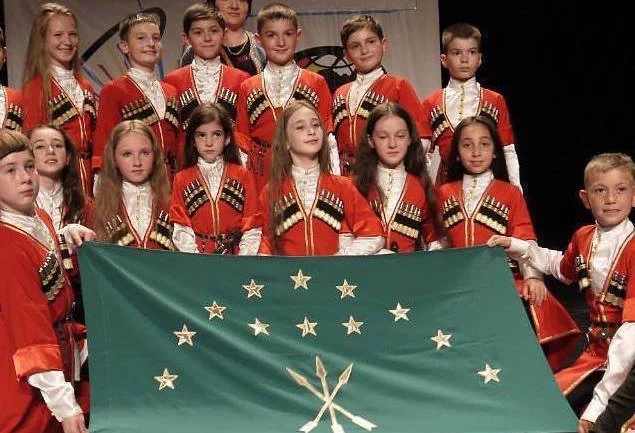
Circassian families keep the language alive above all by speaking it at home, especially between grandparents and grandchildren, and by giving children places to use it: associations, dance groups, school electives where they exist, and apps. It is urgent: by one estimate only about 5% of Circassians in Turkey speak Circassian fluently, and in Jordan just 21% of Circassian children use it at home.
The Circassian language is at a crossroads. In 2009 UNESCO listed it, Kabardian and Adyghe alike, as vulnerable: children still speak it, but often only at home. In the diaspora, many young Circassians grow up speaking Turkish, Arabic, Hebrew, English or German instead. Across the world, though, families are pushing back, and what they do at home decides more than anything else whether the next generation speaks it.
The challenge
Even in the Caucasus, where Kabardian is official in Kabardino-Balkaria and Karachay-Cherkessia and Adyghe in Adygea, Russian is the language everyone shares, and in Adygea the Adyghe are only about a quarter of the population (25.7% in 2021). In Turkey school and work are in Turkish, in Jordan in Arabic.
The few numbers there are show the scale of the problem:
- Turkey, home to the largest Circassian community: one estimate, by Nusret Baş, then president of a federation of Circassian associations, put fluent speakers at about 5%.
- Jordan: about 17% of Circassians speak the language, and surveys find that 21% of children use it at home. Schools long taught only in Arabic, so many parents switched to Arabic at home to help their children at school.
- Israel: speaking has held up well in the Circassian villages, but reading and writing lag behind: in one survey 81.7% reported advanced speaking ability and only 12% could write well.
What families are doing
Speaking Circassian at home. This is the heart of it. Some families keep a simple rule, Circassian inside the house and the majority language outside; others make set times Circassian-only, such as meals or bedtime stories. What matters is doing it every day.
Grandparents. In many families the grandparents are the most fluent speakers. Time with a grandmother or grandfather who speaks Circassian gives a child the language and, with it, the proverbs, songs, stories and everyday Habze that no classroom teaches.
The first words a family uses, from the audio course. Tap to hear each in both dialects:
| Meaning | Kabardian | Adyghe |
|---|---|---|
| mother | анэane | нанэnane |
| father | адэade | ТатэTate |
| grandmother | анэшхуэaneshkhwe | нэнэжъnenezhh |
| grandfather | адэшхуэadeshkhwe | тэтэжъtetezhh |
| child | сабийsabiy | сабыйsabəy |
| my family | Си унагъуэ.Si unaghwe. | СиунагъоSiunagho |
| Circassian (the language) | адыгэбзэadygebze | адыгабзэadygabze |
| Do you speak Circassian? | Адыгэбзэ пщIэра?Adyghebze pshchera? | АдыгабзэкIэ угущаIа?Adəgabzek'e wgushcha'a? |
| I like Circassian. | Адыгэбзэ сфIэфIщ.Adygebze sf'ef'shch. | Адыгабзэ сикIас.Adygabze sik'as. |
Community and culture. Dance groups, music, cultural weekends and gatherings give children friends who share their heritage, and a reason to use the language with them.
Classes and courses. Associations run language classes, and in some countries schools and universities teach it too (see below). Classes cannot replace speaking at home, but they add reading, writing and a community of learners.
Learning together. The Circassian App teaches both Kabardian and Adyghe, in English, Russian, Turkish or Arabic, with short lessons, audio and an alphabet course. Its Family plan shares Premium with up to six people for $99.99 a year (8,890 ₽ in Russia), so parents, children and grandparents can learn side by side. For younger children, Parental controls lock chats, the People tab and friend features behind a 4-digit PIN, while lessons, the alphabet and the leaderboard stay open.
The role of community organizations
No family can keep a language alive alone. Schools, universities and associations do the rest:
- Turkey: associations of KAFFED, the largest federation, run language classes; since 2012 Adyghe can be taken as an elective in state schools when enough students sign up; Düzce University has a Department of Caucasian Languages and Cultures, and Boğaziçi University has offered Adyghe electives since 2013.
- Jordan: the Prince Hamza Ibn Al-Hussein Secondary School in Amman teaches Adyghe to around 750 students, and the Circassian Charity Association supports a school between Naour and Wadi al-Seer that teaches the language.
- Israel: the school in Kfar Kama teaches in Circassian, Hebrew, Arabic and English.
- Online: during the COVID-19 pandemic, online courses let students in Turkey, Jordan and Germany learn from teachers in the Caucasus.
What works
Linguists judge a language’s health first by whether parents pass it on to their children: it is the first of the nine factors in UNESCO’s 2003 framework for language vitality. That is why the home matters most, and why classes, apps and events work best when they feed back into it. The families that succeed tend to combine all of it: they speak the language at home, involve the grandparents, join the community and use the tools available, and their children grow up at home in both their family’s language and their country’s.
Why it matters
Circassian belongs to the Northwest Caucasian family, known for very complex consonant systems with very few vowels; its alphabets have 60 letters for Kabardian and 66 for Adyghe. Its words carry the culture too: the Adyghe адыгагъ, which the app’s Adyghe dictionary explains as the whole of Circassian ethics, from humanity, tact and good manners to honesty, modesty and hospitality, has no one-word translation.
Every family that speaks Circassian at home, every parent who signs a child up for a class and every learner who opens a lesson helps keep it alive, and with it the names, the everyday words and the way Circassians see the world. Start with how to learn Circassian and Kabardian vs Adyghe.
Free on iPhone & Android
Learn Circassian a few minutes a day
Short Kabardian or Adyghe lessons with audio, an alphabet course and an AI tutor. The first lessons work without an account.

4.9 on the App Store 53,000+ people in 100+ countries
Keeping Circassian alive: questions
Is the Circassian language endangered?
UNESCO listed it as vulnerable in 2009, Kabardian and Adyghe alike: children still speak it, but often only at home. In the diaspora it is weaker: about 5% fluent in Turkey by one estimate, 17% of speakers in Jordan.
How can parents teach their children Circassian?
Speak it at home every day, let grandparents speak it with the children, and add classes, community events and apps. The home matters most.
How do you say “grandmother” and “grandfather” in Circassian?
In Kabardian анэшхуэ and адэшхуэ (you can hear “mother”, анэ, and “father”, адэ, at the front), in Adyghe нэнэжъ and тэтэжъ.
Where can children learn Circassian outside the home?
In associations’ classes; in Turkey also as a school elective since 2012 and at Düzce and Boğaziçi universities; in Jordan at the Prince Hamza school in Amman; in Israel at the Kfar Kama school.
Can the whole family use the Circassian App?
Yes. The Family plan shares Premium with up to six people for $99.99 a year (8,890 ₽ in Russia), and Parental controls lock the social features behind a PIN for younger children.
Sources
- Wikipedia (English), “Adyghe language”. en.wikipedia.org/wiki/Adyghe_language
- Wikipedia (English), “Kabardian language”. en.wikipedia.org/wiki/Kabardian_language
- Wikipedia (English), “Endangered language”. en.wikipedia.org/wiki/Endangered_language
- Wikipedia (English), “Northwest Caucasian languages”. en.wikipedia.org/wiki/Northwest_Caucasian_languages
- Wikipedia (English), “Circassians in Jordan”. en.wikipedia.org/wiki/Circassians_in_Jordan
- Wikipedia (English), “Circassians in Turkey”. en.wikipedia.org/wiki/Circassians_in_Turkey
- Wikipedia (English), “Adygea”. en.wikipedia.org/wiki/Adygea
- Wikipedia (English), “Kfar Kama”. en.wikipedia.org/wiki/Kfar_Kama
- The Circassian App: audio course lessons 11, 12, 29 and 30; its Adyghe dictionary (адыгагъ); the Family plan and Parental controls.
Meet Circassians from around the world
Chat with Circassians in Turkey, Jordan, Russia and beyond, and learn Kabardian or Adyghe together in short daily lessons.
Download free53,000+ people in 100+ countries
