The Circassian alphabet is Cyrillic, extended with letter combinations and the palochka (Ӏ) for the many sounds Russian does not have. The app teaches a Kabardian alphabet of 60 letters (the official count is 59; the app adds ЧӀ, a letter of the Adyghe alphabet) and an Adyghe alphabet of 66. Below are all of them, in lesson order, with a native speaker’s recording of every letter that has a sound.
Which alphabet do Circassians use?
Both literary forms of Circassian are written in Cyrillic, the script of Russian. Russian has 33 letters and Circassian needs many more sounds, so the alphabet adds combinations: a base letter plus the palochka (Ӏ), ъ, ь, у or another letter. Each combination counts as one letter and stands for one sound.
There are two versions. The Kabardian (East Circassian) alphabet officially has 59 letters; the Circassian App also teaches ЧӀ, a letter of the Adyghe alphabet, and so counts 60. The Adyghe (West Circassian) alphabet has 66. The difference reflects the two languages’ partly different sounds: comparing the app’s two alphabets, Дзу, Жъ, Жъу, ПIу, ТIу, Цу, Чъ, Шъ, Шъу, ШI, ШIу are found only in Adyghe, while ФI, ЩI, Ху, Кхъ, Кхъу are found only in Kabardian.
All 60 letters of the Kabardian alphabet
Here is the Kabardian (East Circassian) alphabet in the order the app’s 15 alphabet lessons teach it. Under each letter is a rough guide to its sound. Tap a letter to hear it.
Lesson “Vowels I”
Lesson “Vowels II”
Lesson “Simple Consonants I”
Lesson “Simple Consonants II”
Lesson “Simple Consonants III”
Lesson “Simple Consonants IV”
Lesson “Hissing Sounds”
Lesson “The Modifiers”
Lesson “Ejectives I”
Lesson “Ejectives II”
Lesson “Uvular Sounds”
Lesson “Soft & Complex”
Lesson “Labialized I”
Lesson “Labialized II”
Lesson “Affricates & Russian Letters”
Full page: the Kabardian alphabet in its official order, with IPA, example words, a listening quiz and a chart to print.
Letters, sound hints and order from the app’s Kabardian alphabet lessons. Every letter with a sound is a native speaker’s recording; Ъ and Ь have no sound of their own.
All 66 letters of the Adyghe alphabet
And the Adyghe (West Circassian) alphabet, in the order of the app’s 11 Adyghe alphabet lessons. Tap a letter to hear it.
Lesson “Core Vowels”
Lesson “Borrowed Vowels”
Lesson “Basic Consonants I”
Lesson “Basic Consonants II”
Lesson “Consonants III”
Lesson “Adyghe Sibilants”
Lesson “Affricates & Laterals”
Lesson “Ejectives”
Lesson “Uvulars & Modifiers”
Lesson “Labialized I”
Lesson “Labialized II”
Full page: the Adyghe alphabet in its official order, with IPA, example words, a listening quiz and a chart to print.
Letters, sound hints and order from the app’s Adyghe alphabet lessons. Every letter with a sound is a native speaker’s recording; Ъ and Ь have no sound of their own.
Why so many letters?
Because Circassian has a very large number of consonants: Adyghe has between 50 and 60, depending on the dialect. Many of them do not exist in Russian, English or Turkish: ejectives, made with a short burst of air from the throat (КӀ, ПӀ, ТӀ); uvulars, made at the very back of the mouth (Къ, Хъ, Гъ); laterals such as Лъ, close to the Welsh ll; and rounded consonants such as Гу and Ку. Each needs its own letter.
The palochka: the most distinctive letter
The palochka (Ӏ, “little stick” in Russian) looks like a capital I or the number 1, and it is everywhere in written Circassian. On its own it is a glottal stop, a short catch in the throat. After a consonant it turns that consonant into an ejective: К and КӀ, П and ПӀ, Т and ТӀ are completely different sounds.
It is not only Circassian: since the late 1930s the palochka has been used for several languages of the Caucasus, including Abaza, Avar, Chechen, Ingush, Dargwa, Lak and Lezgian. Abkhaz is the exception and does without it. On Russian typewriters, which had no key for it, the digit 1 stood in, and you still see Circassian written with 1 or a Latin I today.
The palochka is typed as a Latin capital I in the app’s lesson data, the way most people type it on a phone keyboard. КI and КӀ are the same letter.
Vowels in Circassian
For all its consonants, Circassian has very few vowels. Kabardian can be analysed as having at most three phonemic vowels, /ə/, /a/ and /aː/, and some linguists have tried to reduce even those. Adyghe also has three phonemic vowels. The other vowel letters stand for variants of these sounds next to different consonants, or for vowels in loanwords.
Historical alphabets
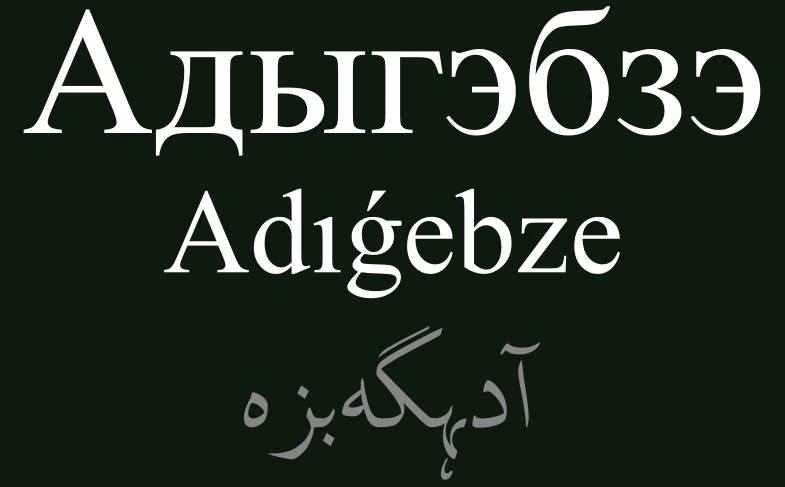
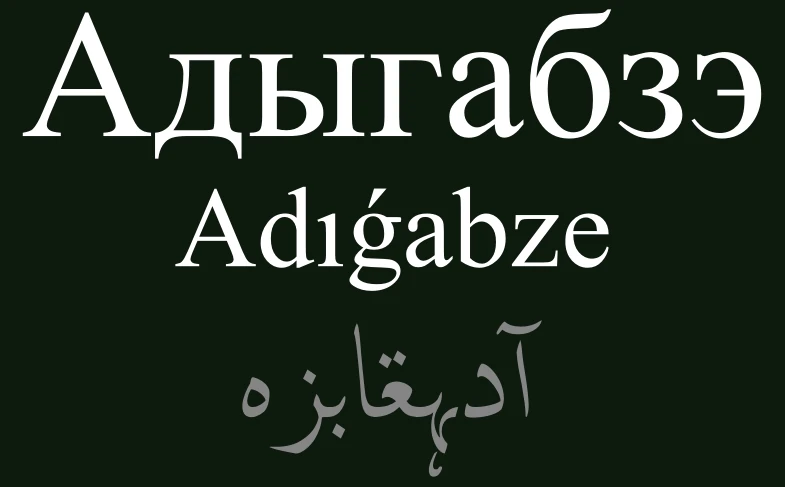
Cyrillic is not the first script Circassians used. In 1853 Umar Bersey published the first Primer of the Circassian Language, in Arabic script; its date, 14 March, is now celebrated as the Day of the Adyghe Language. Arabic-based writing was never widespread, though. In the Soviet period both languages switched to a Latin alphabet (Kabardian was widely written in Latin in 1923–1936, Adyghe in 1927–1938) and then to Cyrillic: Kabardian from 1936, Adyghe from 1938. Cyrillic is the standard in Adygea and Kabardino-Balkaria today, while a Latin alphabet is used in the diaspora, especially in Turkey.
Learning the Circassian alphabet today
If you can read Russian Cyrillic you already know the base letters, and only the combinations and the palochka are new. Start with the letters Russian shares, then move on to the new sounds, one lesson at a time, and listen to each one: the difference between К, КӀ, Къ and Кхъ is much easier to hear than to describe.
The app’s alphabet courses do exactly that: 15 short lessons for Kabardian, 11 for Adyghe, with the native recordings on this page. For practice, Word Search, one of the five Circassian games, hides real words in a grid of Circassian letters. Then go on to hello in Circassian, the essential words and how to learn Circassian.
Free on iPhone & Android
Learn Circassian a few minutes a day
Short Kabardian or Adyghe lessons with audio, an alphabet course and an AI tutor. The first lessons work without an account.

4.9 on the App Store 53,000+ people in 100+ countries
Circassian alphabet: questions
How many letters are in the Circassian alphabet?
The Kabardian alphabet officially has 59 letters (the app teaches 60, adding ЧӀ); the Adyghe alphabet has 66.
What script is Circassian written in?
Cyrillic, with extra letter combinations and the palochka. Before Cyrillic both languages were written in a Latin alphabet in the Soviet 1920s and 1930s, and earlier, less widely, in Arabic script. In the diaspora a Latin alphabet is also used.
What is the palochka?
The letter Ӏ. Alone it is a glottal stop; after a consonant it makes an ejective (К vs КӀ). It is often typed as a Latin I or the digit 1.
Are the Kabardian and Adyghe alphabets the same?
Mostly. Both are Cyrillic, but each has letters the other lacks: Шъ, Жъ, Чъ and ШӀ are Adyghe only, ФӀ, ЩӀ and Кхъ Kabardian only.
Why does Circassian need so many letters?
Because it has many consonants Russian lacks, between 50 and 60 in Adyghe depending on the dialect, and each needs its own letter or combination.
Is the Circassian alphabet hard to learn?
The base letters are Russian Cyrillic; the new part is the combinations and their sounds. Short lessons with audio make it manageable: the app teaches it in 15 Kabardian or 11 Adyghe lessons.
Sources
- Letters, lesson order, sound hints and recordings: the Circassian App’s Kabardian and Adyghe alphabet courses (version 5.8), checked October 5, 2026.
- Wikipedia (English), “Kabardian language”. en.wikipedia.org/wiki/Kabardian_language
- Wikipedia (English), “Adyghe language”. en.wikipedia.org/wiki/Adyghe_language
- Wikipedia (English), “Adyghe phonology”. en.wikipedia.org/wiki/Adyghe_phonology
- Wikipedia (English), “Adyghe alphabet”. en.wikipedia.org/wiki/Adyghe_alphabet
- Wikipedia (English), “Palochka”. en.wikipedia.org/wiki/Palochka
- Wikipedia (Russian), «Адыгейская письменность». ru.wikipedia.org/wiki/%D0%90%D0%B4%D1%8B%D0%B3%D0%B5%D0%B9%D1%81%D0%BA
- Wikipedia (Russian), «Кабардино-черкесская письменность». ru.wikipedia.org/wiki/%D0%9A%D0%B0%D0%B1%D0%B0%D1%80%D0%B4%D0%B8%D0%BD
Learn Circassian in a few minutes a day
Short lessons in Kabardian or Adyghe. Hear how the words sound, learn to read the alphabet, then practice with an AI tutor who replies in Circassian.
Download free53,000+ people in 100+ countries
