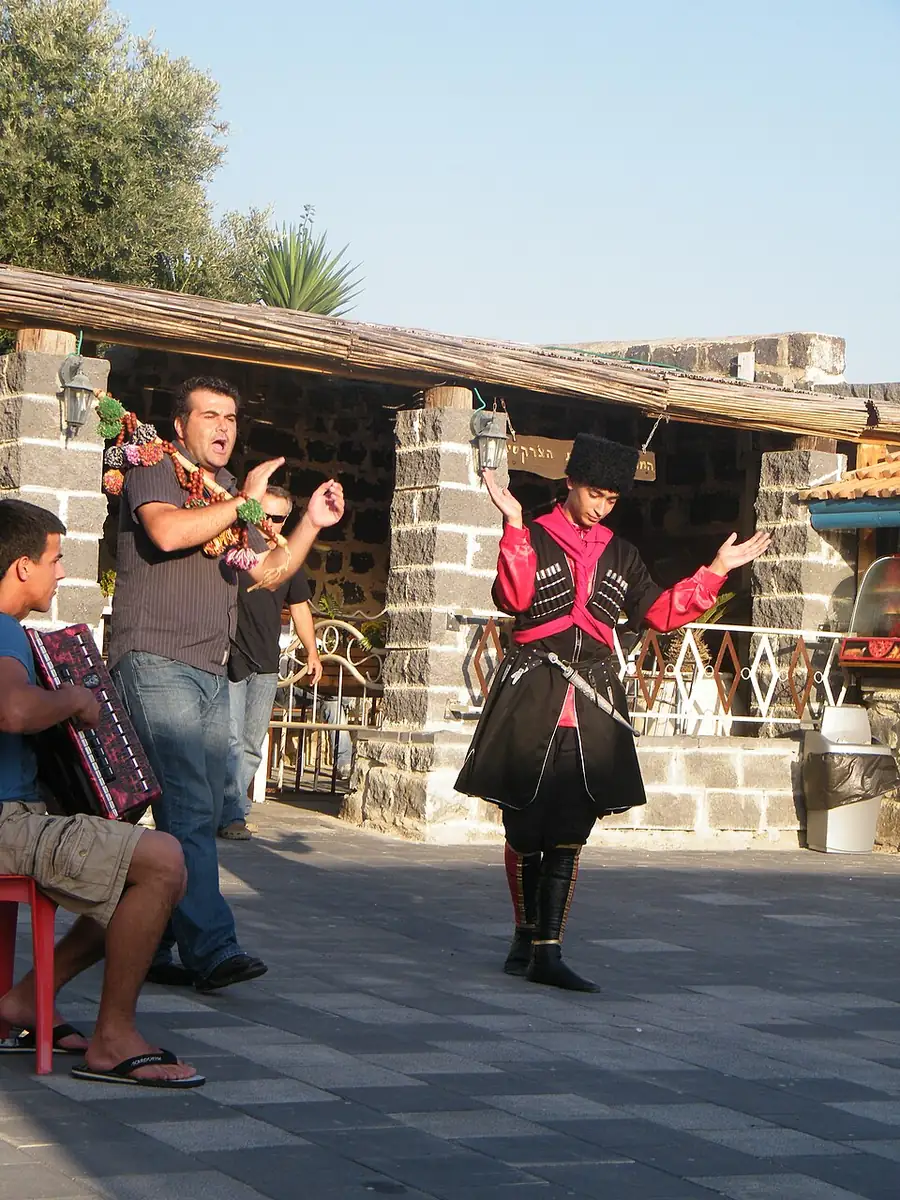
About 5.3 million Circassians live around the world, and most of them outside the Caucasus. Turkey has by far the largest community, 2 to 3 million people; about 750,000 live in Russia, in Adygea, Kabardino-Balkaria, Karachay-Cherkessia and Krasnodar Krai; and there are long-standing communities in Jordan, Syria and Israel, and newer ones in Germany and the United States.
Most Circassians do not live in the Caucasus. Their families settled in the Ottoman Empire in the 19th century, and their descendants live today in Turkey, Jordan, Syria and Israel; later moves took Circassians on to Germany, the United States and other countries. Here is where the communities are, how large they are, and what holds them together. Every country links to its own page with the full story and sources.
Where Circassians live: at a glance
| Country | Circassians | Share of the largest |
|---|---|---|
| Turkey | 2–3 million | |
| Russia | about 750,000 | |
| Jordan | 100,000–170,000 | |
| Syria | about 100,000 before 2011 | |
| Germany | about 40,000 | |
| United States | 8,000–15,000 | |
| Israel | 4,000–5,000 |
Estimates from the sources below; ranges show low and high estimates. Russia: the figure given for Adygea, Krasnodar Krai, Kabardino-Balkaria and Karachay-Cherkessia together.
Turkey: the largest community
With 2 to 3 million people of Circassian descent, Turkey has the largest Circassian community in the world, far more than Russia, and one of the country’s largest ethnic minorities. Circassian villages are spread over the Marmara region, Central Anatolia and the Black Sea coast, in provinces such as Kayseri, Samsun, Tokat, Sivas, Düzce and Sakarya, and many families live in Istanbul. Kabardians are the largest group, followed by the Abzakh and the Shapsug.
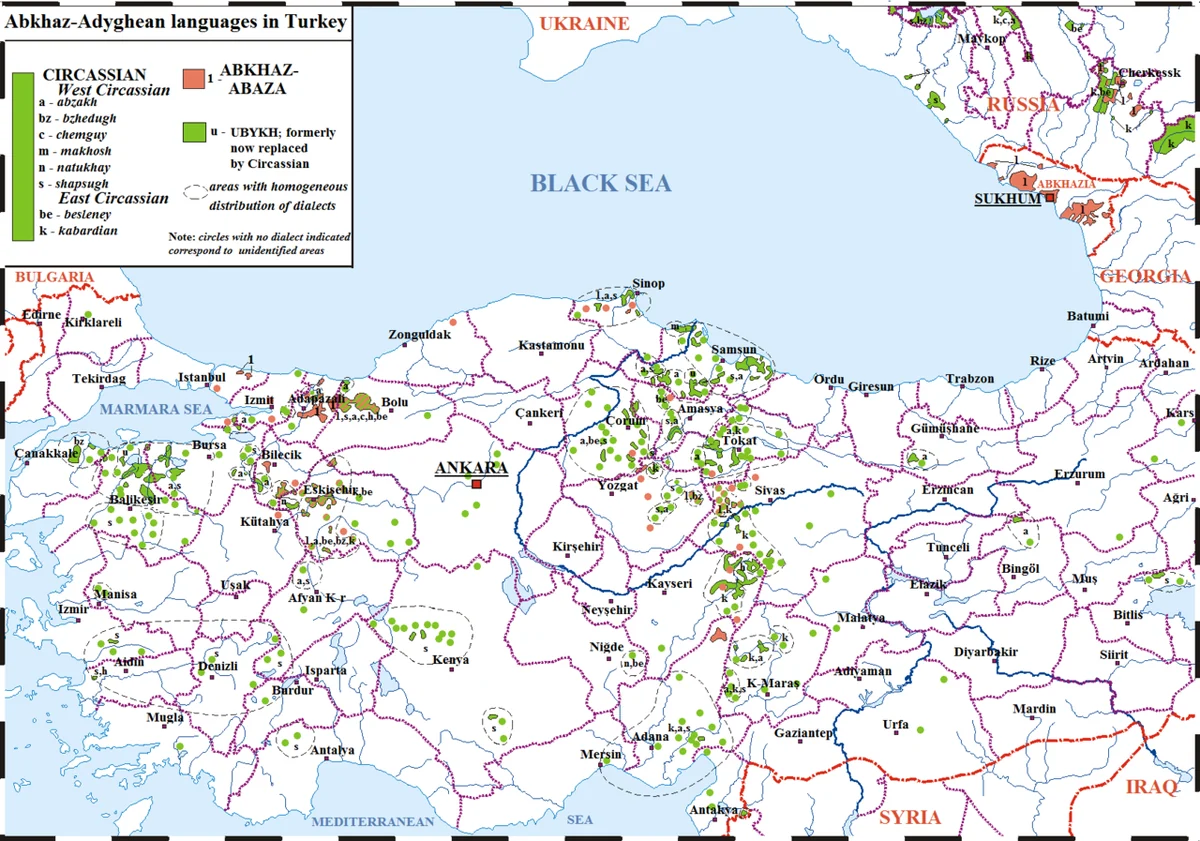
KAFFED, the Federation of Caucasian Associations, is the largest Circassian organisation, and since 2004 Turkish state radio and television have broadcast in Kabardian. Keeping the language is the hard part: one community leader estimated that only about 5% speak it fluently. More in Circassians in Turkey.
Jordan: a historic role
About 100,000 to 170,000 Circassians live in Jordan. They settled Amman in 1878, then Wadi al-Seer and Jerash, and revived Amman, which had been largely abandoned for centuries. Circassians serve in the king’s Circassian Bodyguard, hold three seats in parliament together with the Chechens, and the Circassian Charity Association, founded in 1932, is the country’s oldest charity. About 17% of Jordan’s Circassians speak Adyghe. More in Circassians in Jordan.
Syria and Israel
Circassians have lived in Syria since the 1870s, in and around Damascus, Aleppo and Homs. Before 2011 the community was estimated at about 100,000, and many still speak Adyghe alongside Arabic; since then many have moved to Turkey, Jordan, Europe and the North Caucasus. More in Circassians in Syria.
About 4,000 to 5,000 Circassians live in Israel, in two villages settled in the 1870s: Kfar Kama in the Lower Galilee, mostly Shapsug, and Rehaniya in the Upper Galilee, mostly Abzakh. Kfar Kama’s school teaches in Circassian, Hebrew, Arabic and English, both villages have a centre for Circassian heritage, and in 2018 the footballer Bibars Natcho from Kfar Kama became the first captain of Israel’s national team of Circassian or Muslim origin. More in Circassians in Israel.
Europe and the Americas
Germany has around 40,000 Circassians, most of them families who came from Turkey from the 1960s, after the labour agreement of 1961. Europe’s first Caucasian cultural association was founded in Munich in 1968, and a Federation of Circassian Cultural Associations in Europe followed in 2004; there are also communities in the Netherlands, Belgium, France, Switzerland and Austria. Only 18% of Circassians in Europe say they are fluent in their mother tongue. More in Circassians in Germany.
The United States has 8,000 to 15,000 Circassians, with the largest community in New Jersey around Paterson. The Circassian Benevolent Association, founded in 1952, runs a community centre, a mosque and a Sunday school for the language and history. In 2026 the film Butterfly Jam, about Circassians in New Jersey, opened the Directors’ Fortnight at Cannes. More in Circassian Americans.
The Caucasus homeland
About 750,000 Circassians live in Russia, in the republics of Kabardino-Balkaria, Adygea and Karachay-Cherkessia and in Krasnodar Krai. In Kabardino-Balkaria Kabardians are the majority, 57.1% of the population in 2021. In Adygea the Adyghe make up 25.7%, and Adyghe is an official language alongside Russian. In Karachay-Cherkessia, whose capital is Cherkessk, the Cherkess make up 12.7%, and Kabardian is one of the five official languages. The two literary languages, East (Kabardian) and West (Adyghe), are explained in Kabardian vs Adyghe.
Repatriation
Links with the homeland go both ways. Jordan’s Circassian Charity Association sends students on scholarships to Kabardino-Balkaria and Adygea, and since 2011 many Syrian Circassian families have moved to Adygea, Kabardino-Balkaria and Karachay-Cherkessia. Still, as the numbers above show, most Circassians live outside the Caucasus, so the language and customs travel with them.
What connects the diaspora
Wherever they live, Circassians share Habze, the code of manners and honour; the dances, still danced at weddings and festivals from Syria and Kfar Kama to New Jersey; and the Circassian flag, green with twelve gold stars and three crossed arrows, celebrated on Circassian Flag Day, 25 April. Associations, from KAFFED in Turkey to the charity in Amman and the Benevolent Association in New Jersey, keep communities together.
The language is the hardest part to keep: by one estimate only about 5% of Circassians in Turkey speak it fluently, 17% of Jordan’s Circassians speak Adyghe, and 18% of Circassians in Europe say they are fluent. That is why learning it matters, wherever you live: start with how to learn Circassian, and read more on who the Circassians are.
Meet Circassians from everywhere
The Circassian App brings Circassians from many countries together: community chats (a general chat, Turkish and Arabic chats, a Circassian-only room and a chat for women), voice rooms, private messages and a people search for finding other Circassians. It also teaches Kabardian and Adyghe in short lessons with audio, so you can pick up the language on the way. It is free on iPhone and Android.
Free on iPhone & Android
Meet Circassians from around the world
Community chats, voice rooms and private messages, plus Kabardian or Adyghe lessons to learn the language along the way.

4.9 on the App Store 53,000+ people in 100+ countries
The Circassian diaspora: questions
How many Circassians are there in the world?
About 5.3 million, most of them outside the Caucasus.
Where do most Circassians live?
In Turkey, home to 2 to 3 million people of Circassian descent, the largest community in the world.
Why do most Circassians live outside the Caucasus?
Their families settled in the Ottoman Empire in the 19th century, which is why Turkey, Jordan, Syria and Israel have long-standing communities.
How many Circassians live in Russia?
About 750,000, in Kabardino-Balkaria, Adygea, Karachay-Cherkessia and Krasnodar Krai.
Where do Circassians live in Europe and America?
Germany has the largest community in Europe, around 40,000; the United States has 8,000 to 15,000, mostly in New Jersey.
Sources
- Wikipedia (English), “Circassians”. en.wikipedia.org/wiki/Circassians
- Wikipedia (English), “Circassians in Turkey”. en.wikipedia.org/wiki/Circassians_in_Turkey
- Wikipedia (English), “Circassians in Jordan”. en.wikipedia.org/wiki/Circassians_in_Jordan
- Wikipedia (English), “Circassians in Syria”. en.wikipedia.org/wiki/Circassians_in_Syria
- Wikipedia (English), “Circassians in Israel”. en.wikipedia.org/wiki/Circassians_in_Israel
- Wikipedia (English), “Circassians in Germany”. en.wikipedia.org/wiki/Circassians_in_Germany
- Wikipedia (English), “Circassian Americans”. en.wikipedia.org/wiki/Circassian_Americans
- Wikipedia (English), “Kabardino-Balkaria”. en.wikipedia.org/wiki/Kabardino-Balkaria
- Wikipedia (English), “Adygea”. en.wikipedia.org/wiki/Adygea
- Wikipedia (English), “Karachay-Cherkessia”. en.wikipedia.org/wiki/Karachay-Cherkessia
- Wikipedia (English), “Circassian flag”. en.wikipedia.org/wiki/Circassian_flag
- Each country page on this site lists its own sources: Turkey, Jordan, Syria, Israel, Germany, United States.
Meet Circassians from around the world
Chat with Circassians in Turkey, Jordan, Russia and beyond, and learn Kabardian or Adyghe together in short daily lessons.
Download free53,000+ people in 100+ countries
