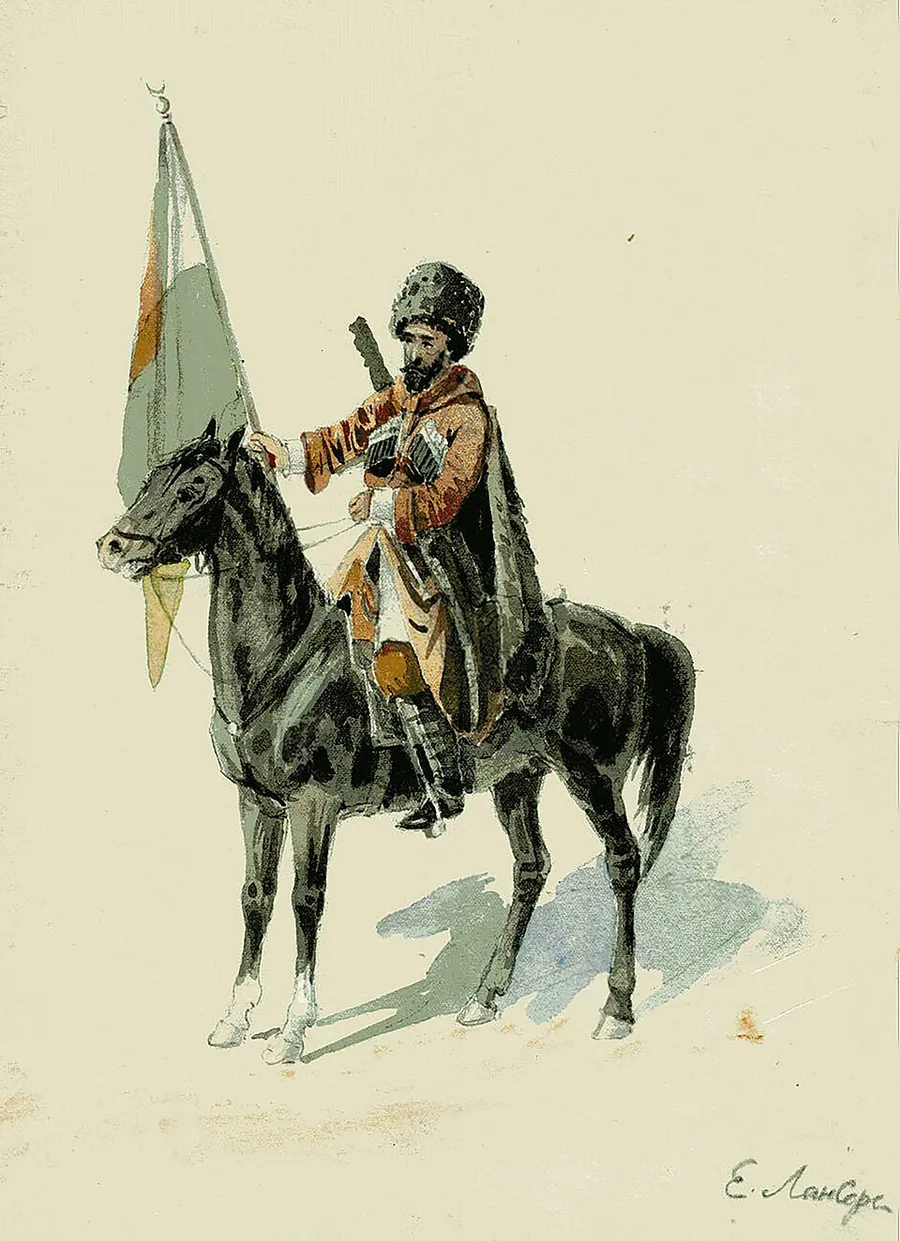
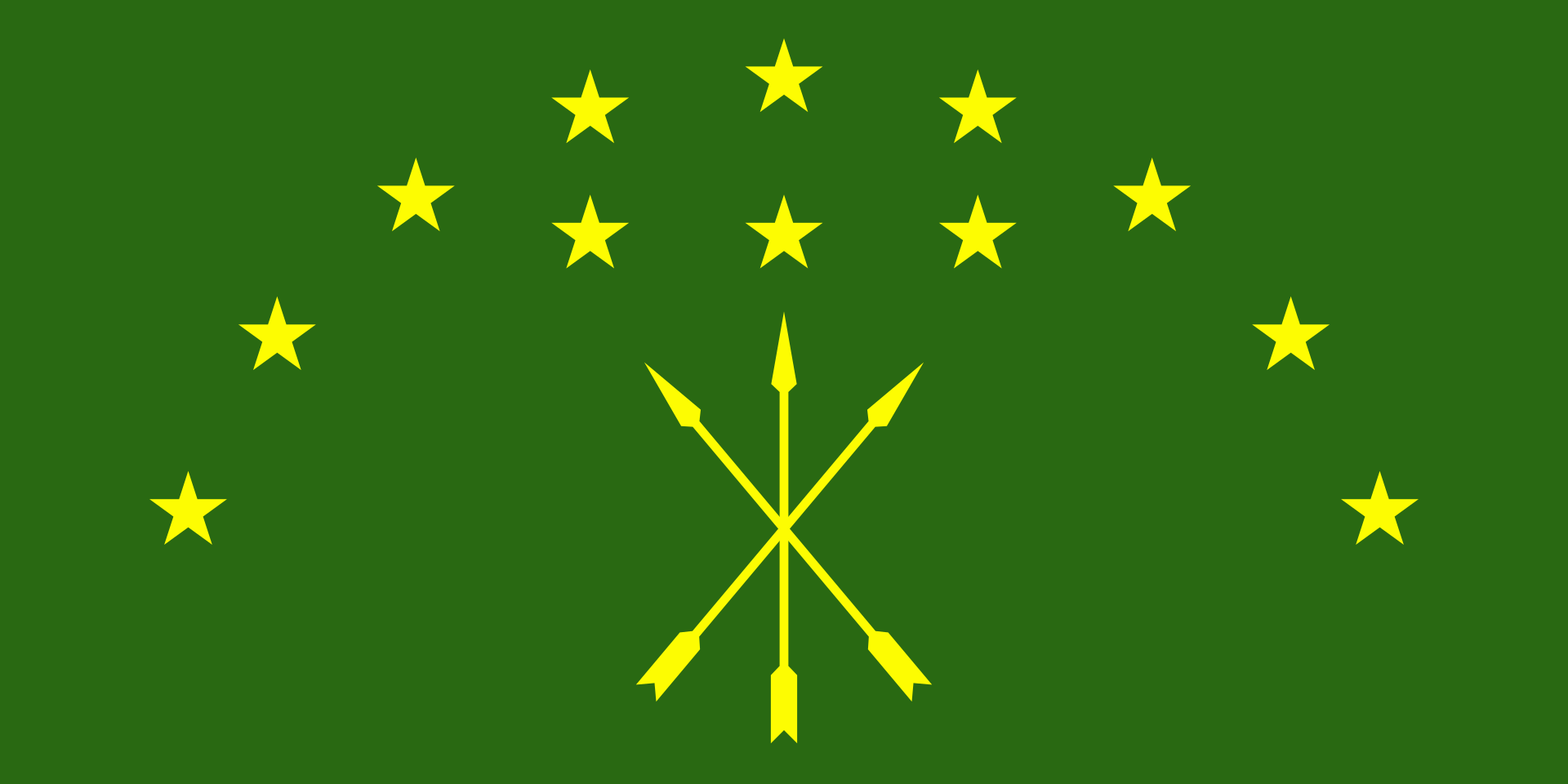
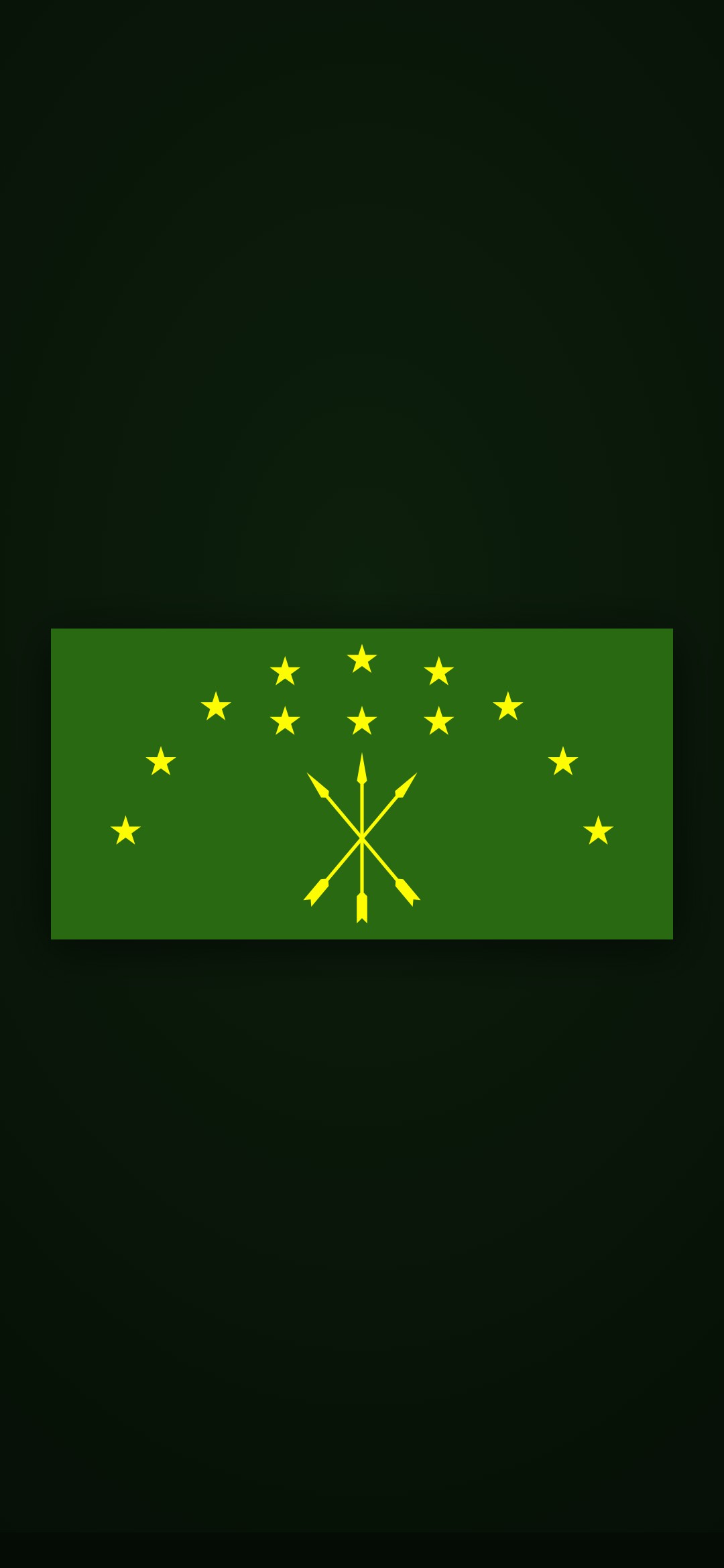
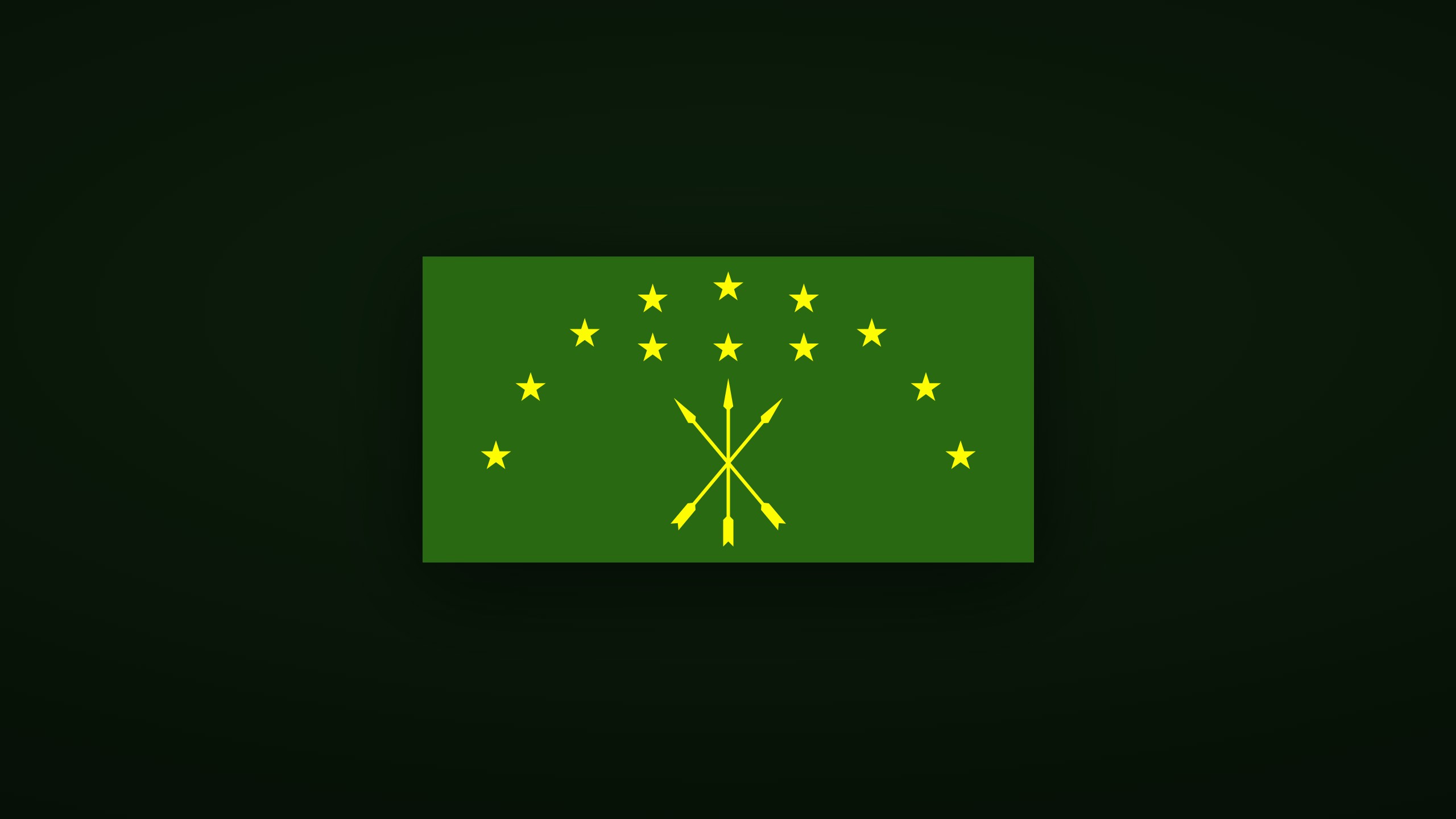
The Circassian flag is green with twelve gold stars, nine in an arc and three in a row, and three crossed gold arrows. The stars stand for the twelve Circassian tribes, and the arrows, by the Habze rule that a hunter may shoot only three arrows, mean that Circassians do not seek war. Designed in the early 1830s and first raised in 1836, it is the official flag of the Republic of Adygea since 1992, and 25 April is Circassian Flag Day.
What the flag looks like
The Circassian flag (Адыгэ нып, “Adyghe flag”) is a dark green field in the proportions 1:2. On it are twelve gold five-pointed stars: nine form an arc that looks like a bow, and three stand in a straight row under its top. Three gold arrows cross in the centre.
The meaning behind each element
- Green. Two explanations exist. One reads it as Islamic: the British observer James Bell linked the flag to the Ottoman “blessed banner”. The other follows traditional Circassian colour meanings, where green is nature, life, hope, eternity and peace.
- Gold. A bright and peaceful future, and a plentiful harvest of grain.
- Twelve stars. The twelve Circassian tribes, all the same size: no tribe above another. In one reading the nine stars in the arc are the nine aristocratic tribes, ruled by princes, and the three in a row the three democratic tribes, the Natukhai, Shapsug and Abdzakh, which governed themselves through assemblies.
- Three arrows. A rule of Habze: on one hunt a hunter could shoot only three arrows. Three arrows meant a hunt, not a war, so on the flag they say that Circassians do not seek conflict but will defend themselves. In Circassia three arrows became a symbol of peace.
Origins of the flag
No written source describes how the flag was designed. By oral tradition it was the work of Seferbiy Zaneqo, the Circassians’ representative in Istanbul, in the early 1830s: twelve stars, one for each tribe, equally represented, and three arrows for peace. A Circassian woman in the Ottoman imperial harem made the banner. The symbols themselves were older: Zaneqo’s family knew the arrows and stars from the Kabardian coat of arms, and a Kabardian banner of the 18th century already carried arrows and stars embroidered in gold.
In 1836 the flag was brought to Circassia and raised at a great gathering of Circassian leaders on the banks of the Ubin river, in Shapsugia. The English traveller Edmund Spencer, who was there, described the scene. The Scottish diplomat David Urquhart later claimed to have designed the flag, but no evidence for his claim has been found.
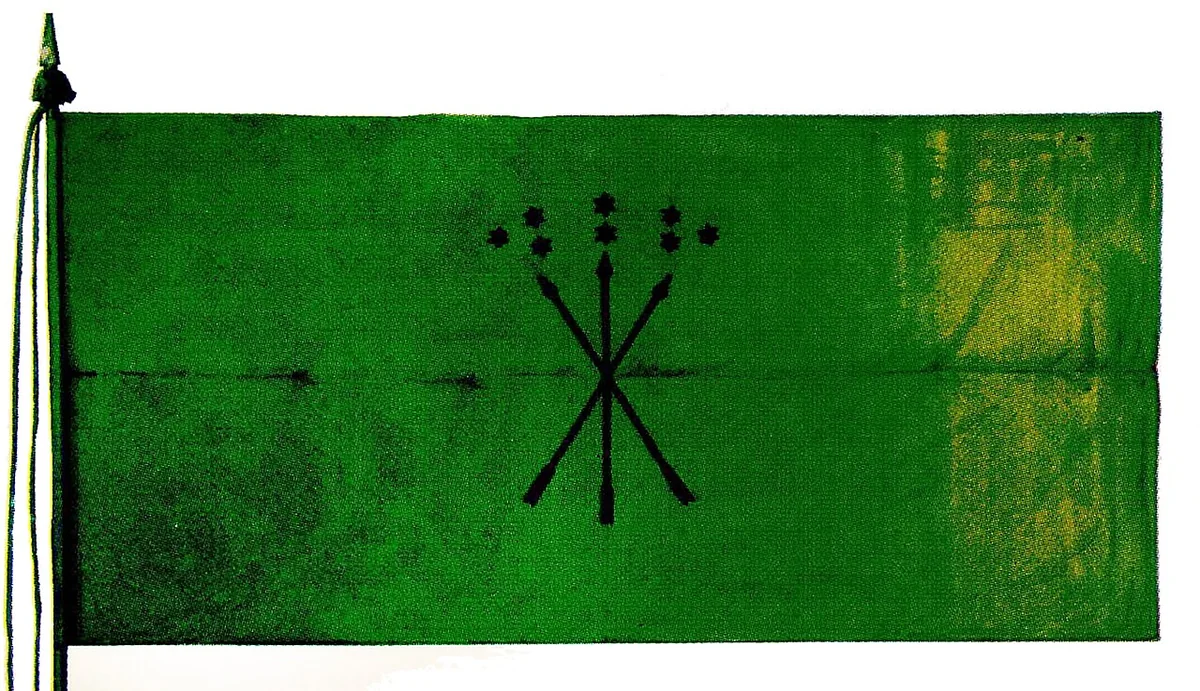
Early versions differed: an 1837 sea chart shows the flag with eight stars and three arrows, and the banner above, now in the National Museum of the Republic of Adygea, has eight six-pointed black stars. The flag travelled with the Circassians who settled in the Ottoman Empire in the 19th century and lived on in the diaspora. It returned to the Caucasus in 1989, when Ibrahim Nawurjan, a history student at the Kabardino-Balkarian State University, found Spencer’s book and recreated the flag from its description; it became the symbol of the Circassian association in Nalchik.
60-second lesson
The flag’s colors and two more, in Circassian
The flag is green and gold: here are green, yellow (for the gold) and “star”, then red and white, in both dialects. Tap a word to hear it in Kabardian (East) and Adyghe (West), then take the quiz: the app’s own question, five rounds.
The quiz needs JavaScript.
In the app, questions like these are in every lesson, and the words you get wrong come back for review sooner.
All the colors, in both dialects, with example sentences: Colors in Circassian.
The flag as Adygea’s official flag
On 24 March 1992 the Republic of Adygea adopted the Circassian flag as its state flag (Law No. 2 “On the State Flag of the Republic of Adygea”). The national flag of the Circassians and the official flag of Adygea are one and the same. More in Adygea, the Circassian homeland.
The flag in the diaspora
Outside the Caucasus the flag is everywhere Circassians are: at weddings and festivals, on walls, on cars and on clothes, a quiet way of telling other Circassians who you are.
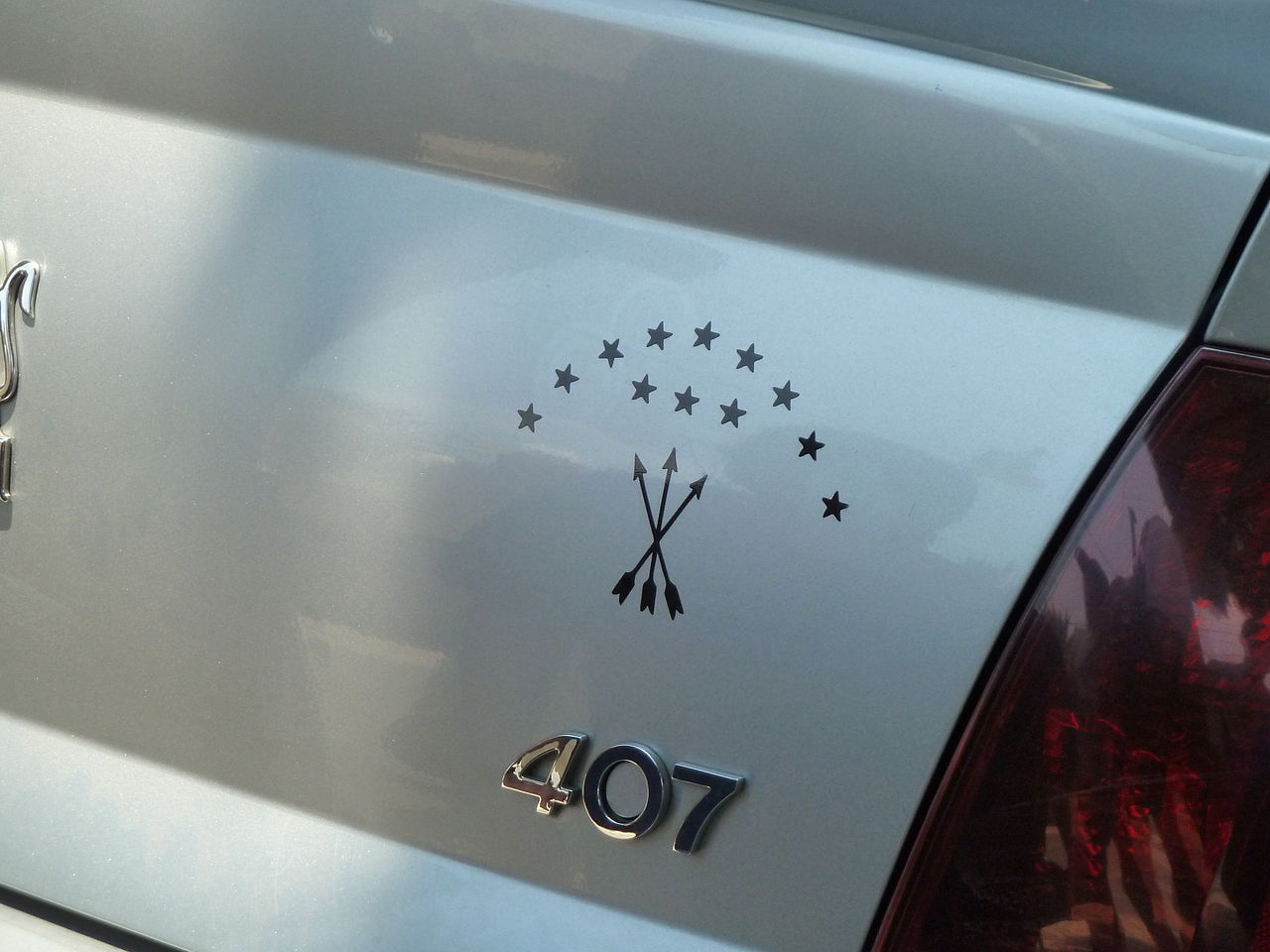
Read about the diaspora in the Circassian diaspora today and Circassians in Israel. There is no flag emoji yet; here is what to use instead.
The twelve tribes
The twelve stars stand for the twelve traditional Circassian tribes: the Abdzakh, Besleney, Bzhedug, Hatuqwai, Kabardian, Mamkhegh, Natukhai, Shapsug, Temirgoy, Ubykh, Yegeruqwai and Zhaney. Each had its own lands and leaders, and all called themselves Adyghe. More in What does Adyghe mean?
25 April: Circassian Flag Day
Every year on 25 April, Circassians around the world mark Circassian Flag Day, with events in Adygea, Kabardino-Balkaria, Karachay-Cherkessia, Krasnodar Krai and wherever Circassians live. In Adygea the date has been set in law since 2013 as the Day of the State Flag of the Republic of Adygea. The other Circassian holidays are on our page about Circassian holidays.
Flag wallpapers
Three free wallpapers with the complete flag, the full official construction with all twelve stars, on a dark background. Tap to download; no watermark.

The flag and Circassian identity
The flag carries one idea: the Circassians live in many countries but are one people. A Kabardian, a Shapsug or an Abdzakh can all find their star in it. In Kabardian the flag is нып , a star is вагъуэ and an arrow is шабзэ.
The flag of Adygea, the Circassian national flag and the flag waved at a wedding in Amman or Istanbul are the same design.
Free on iPhone & Android
Circassian language and culture, in one app
Kabardian and Adyghe lessons, Habze culture lessons, a library of books, films and music, and Circassians from around the world to talk to.

4.9 on the App Store 53,000+ people in 100+ countries
The Circassian flag: questions
What does the Circassian flag mean?
The twelve gold stars stand for the twelve Circassian tribes, the three crossed arrows for peace (by Habze a hunter shot only three arrows, so they meant hunting, not war), green for nature, life and peace or for Islam, and gold for a bright future and a good harvest.
Why are there 12 stars on the Circassian flag?
One for each of the twelve traditional Circassian tribes. In one reading the nine in the arc are the aristocratic tribes and the three in a row the democratic Natukhai, Shapsug and Abdzakh.
Who designed the Circassian flag?
By oral tradition Seferbiy Zaneqo, in the early 1830s; no written source describes the design. David Urquhart also claimed it, without evidence.
Is the Circassian flag the flag of Adygea?
Yes. The Republic of Adygea adopted it as its state flag on 24 March 1992.
When is Circassian Flag Day?
25 April. In Adygea it has been the Day of the State Flag of the Republic of Adygea by law since 2013.
What is “flag” in Circassian?
Нып. The flag of the Circassians is Адыгэ нып.
Sources
- Wikipedia (English), “Circassian flag”. en.wikipedia.org/wiki/Circassian_flag
- Wikipedia (English), “Circassians”. en.wikipedia.org/wiki/Circassians
- Wikipedia (Russian), «Флаг Адыгеи». ru.wikipedia.org/wiki/%D0%A4%D0%BB%D0%B0%D0%B3_%D0%90%D0%B4%D1%8B%D0%B
- Words: the Circassian App’s lessons and its Kabardino-Cherkess–Russian dictionary (Apazhev & Kokov, 2008), pp. 52, 341, 563.
Want more like this?
The app has 64 short lessons on Circassian culture and Habze, plus a course in Kabardian or Adyghe to learn the language behind them.
Download free53,000+ people in 100+ countries
