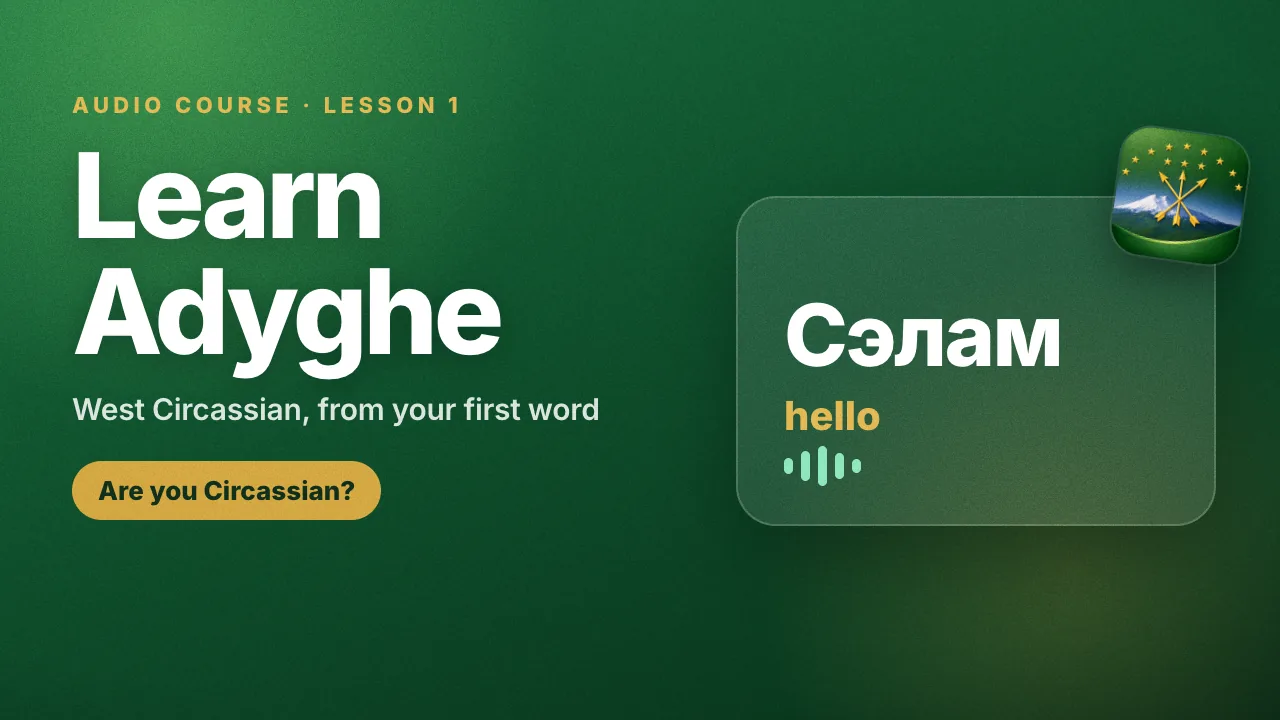
Adyghe, or West Circassian, is one of the two literary forms of Circassian. It is one of the two official languages of the Republic of Adygea, alongside Russian, and most of its speakers live in the diaspora, in Türkiye, Jordan, Syria and Israel. The Circassian App teaches it in a course of its own: 119 lessons with audio, a 66-letter alphabet with native-speaker recordings, an audio course and an AI tutor who answers in Adyghe. The lesson at the top of this page is the course’s real first lesson.
Both branches of the Circassian language
Circassian has two literary forms. Adyghe is West Circassian; Kabardian is East Circassian, spoken in Kabardino-Balkaria and Karachay-Cherkessia. They share most of their history and much of their grammar, but they differ already in the first lesson, in words, sounds and spelling. A learner who mixes them ends up speaking neither, so the app keeps them apart: each has its own course, its own alphabet and its own audio. Here are the first two lessons of both, with the app’s audio:
| English | Kabardian | Adyghe |
|---|---|---|
| hello | ФIэхъусF'eĥus | СэламSelam |
| how are you | Дауэ ущыт?Dawe ushchyt? | Сыд фэдэу ущыт?Syd fedeu ushchyt? |
| good | фIыщf'yshch | дэгъуdeghu |
| and you? | Уэ щэ?We shche? | оры?orə? |
| I am well | СыузыншэщSyuzynsheshch | СыпсауSypsaw |
| goodbye | ФIыкIэF'yk'e | ХъяркIэKhyark'e |
| thank you | УпсэуUpsew | ТхьауегъэпсэуThaweyeghepsey |
| please | кхъыIэkh'yIe | сыолъэIуsyolheIw |
| I understand | КъызгурыIуэQyzguryI'we | КъызгурэIоQyzgureIo |
| I don't understand | КъызгурыIуэркъымQyzguryI'werqym | КъызгурэIорэпQyzgureIorep |
If your family comes from Adygea, or is Abzakh, Shapsug, Bzhedug or Hatuqay, Adyghe is your branch. More in Kabardian vs Adyghe: what is the difference?
The Adyghe alphabet, with sound
Adyghe is written in Cyrillic with 66 letters: the Russian ones plus combinations and the palochka (Ӏ) for sounds Russian does not have. The app teaches them in 11 short lessons, from the vowels to the labialized consonants. Every letter with a sound of its own (all but Ъ and Ь) is a native speaker’s recording. Tap a letter to hear it:
Lesson “Core Vowels”
Lesson “Borrowed Vowels”
Lesson “Basic Consonants I”
Show the other 49 letters
Lesson “Basic Consonants II”
Lesson “Consonants III”
Lesson “Adyghe Sibilants”
Lesson “Affricates & Laterals”
Lesson “Ejectives”
Lesson “Uvulars & Modifiers”
Lesson “Labialized I”
Lesson “Labialized II”
Letters, sounds and lesson order from the app's alphabet course. Every letter with a sound is a native speaker's recording: tap to hear it.
A real curriculum, not a phrasebook
After the alphabet comes the course: 10 sections and 119 lessons, each a few minutes long. You choose meanings, find words you hear, and build sentences from tiles. Words you miss come back in later lessons until they stick. Mistakes cost a heart (you have five, and one comes back every four hours); practice and replays never do.
- 1Foundations15 lessonsHello! · About Me · Family · Numbers · Colors · Essentials
- 2My World18 lessonsFarm Animals · Wild Animals · Food · Drinks · Elements · Landscape · Around the House
- 3Actions & Time19 lessonsBasic Verbs · More Actions · Expressive Actions · Time · Seasons & Weather · Telling Time
- 4Describing the World12 lessonsAdjectives 1 · Adjectives 2 · Body Parts · Health · Emotions
- 5Daily Life13 lessonsClothing · Places · People & Roles · More Professions · Numbers 11-100
- 6Going Places13 lessonsGetting Around · Directions · At the Hotel · Countries & Origins · Months & Calendar
- 7Social Life11 lessonsAt the Restaurant · Shopping · Technology · Hobbies & Sports · Weather
- 8Deeper Conversations8 lessonsEmergencies · Daily Routine · Opinions & Feelings
- 9Circassian Heritage6 lessonsHeritage · Traditions · The Diaspora
- 10Grand Finale4 lessonsGrand Review
Your first four weeks
A pace that works for most beginners, at 10 to 20 minutes a day:
| When | What to do |
|---|---|
| Week 1 | The alphabet: 11 short lessons, one or two a day. Replay each letter until the sound feels familiar. |
| Week 2 | First words, section 1, Foundations (15 lessons): Hello!, About Me, Family, Numbers, Colors, Essentials. |
| Week 3 | Your world, section 2, My World (18 lessons): Farm Animals, Wild Animals, Food, Drinks, Elements, Landscape, Around the House. |
| Week 4 | Put it to use: the four free audio-course lessons on a walk, your first messages to Кызбеч, and a duel against a real opponent. |
Learn Adyghe by ear
The audio course trains listening and speaking without a screen: 31 lessons, narrated in English, Russian, Turkish or Arabic. The narrator asks you to say something, you answer out loud in the pause, then you hear it in Adyghe. With the English narrator the course runs about 8.2 hours. The first four lessons are free. More on the audio course page.
All 31 lessons of the Adyghe audio course
- 0How this course worksfree · 1 min
- 1Are you Circassian?free · 6 min
- 2Do you understand me?free · 12 min
- 3What's your name?free · 12 min
- 4Do you speak Circassian?11 min
- 5Where are you from?11 min
- 6I want, I don't want16 min
- 7Eating and drinking17 min
- 8Come here! This and that16 min
- 9Numbers 1 to 516 min
- 10Numbers 6 to 1016 min
- 11My family16 min
- 12House and garden17 min
- 13Where is it?19 min
- 14How old are you?19 min
- 15Who, what, why?18 min
- 16Good morning, good night17 min
- 17What time is it?18 min
- 18Making plans19 min
- 19Safe journey!18 min
- 20I have to go19 min
- 21How do you feel?18 min
- 22My head hurts17 min
- 23How much is it?18 min
- 24The past tense20 min
- 25Yesterday's story19 min
- 26Tomorrow I'll go18 min
- 27Today is cold18 min
- 28What do you like?18 min
- 29Welcome!16 min
- 30The whole story16 min
Кызбеч, your Adyghe tutor
Кызбеч is the app’s AI tutor for Adyghe (Сэтэней-гуащэ teaches Kabardian). He replies in Adyghe with a translation and can read his replies aloud. This is his real first message; the first four messages are free with a free account.
Built around Habze
Habze (also written Xabze) is the Circassian code of conduct, and the app teaches it alongside the language: 16 units of 4 lessons, each a real situation with an explanation after every answer.
- Core Values
- Hospitality
- Warrior Code
- Respect & Family
- Proverbs & Wisdom
- Nart Mythology
- Marriage & Wedding
- Music & Dance
- Traditional Dress
- Cuisine & Table
- Democratic Council
- Horse Culture
- Craftsmanship
- Nature & Sacred Places
- Circassian Tribes
- Festivals & Traditions
For practice there are also five games, from a sword duel against real opponents to Word Rain.
Free, and what Premium adds
Free
- All 119 lessons of the Adyghe course (and the Kabardian one)
- The 66-letter alphabet, with native-speaker recordings
- 64 Habze lessons
- An Adyghe word list in the Translate screen
- The first 4 audio-course lessons
- 4 messages to Кызбеч
- Chats, voice rooms and games
With Premium
- Unlimited hearts: mistakes never pause a lesson
- The full audio course: 31 lessons
- Кызбеч without limits
- Auto-translate in chats, and more
- A Family plan: one yearly plan for up to 6 people
New subscribers get 3 days free. Your app store shows the price in your currency.
From heritage learners and the diaspora
The app is rated 4.9 out of 5 from 285 ratings on the App Store. Reviews, word for word:
“Очень классное и проработанное приложение. С кайфом прошел весь курс Адыгейского. Разработчики молодцы.”Translated from Russian: “A really cool, well-made app. I loved working through the whole Adyghe course. Well done, developers.”
“Это оно самое, надеюсь с этим приложением подтяну свой Адыгабзэ”Translated from Russian: “This is the one. I hope this app helps me brush up my Adygabze.”
“A great app where you can learn Circassian language and Xabze, and meet people from both diaspora and the homeland in there”
“The best app I have ever used
Preserving and learning Circassian has never been easier”
Free on iPhone and Android
Start learning Adyghe today
119 lessons with audio, the 66-letter alphabet, the audio course and Кызбеч. The first lesson needs no account.

4.9 on the App Store 53,000+ people in 100+ countries
Common questions about learning Adyghe
Does the app teach Western Adyghe (Adygea Republic)?
Yes. The Adyghe course is West Circassian, the language of the Republic of Adygea, with its own 66-letter alphabet, words and audio. The app also has a separate Kabardian (East Circassian) course; the two are never mixed.
What does "Adyghe" actually mean?
Adyghe (Адыгэ) is the native self-name of the Circassian people. In common usage it covers all Circassians. In linguistic classification it is often used narrowly for Western Circassian only. The app covers both branches: Adyghe (Western) and Kabardian (Eastern).
What alphabet does it use?
Both dialects are written in Cyrillic, with letter combinations and the palochka (Ӏ) for sounds Russian does not have. In the app, the Adyghe alphabet has 66 letters and the Kabardian alphabet 60, and every letter with a sound is recorded by a native speaker.
How many people speak Adyghe?
Estimates vary. Ethnologue, as cited by Wikipedia, puts Adyghe at about 600,000 speakers and Kabardian at about 1.9 million. Adyghe is one of the two official languages of the Republic of Adygea, and most of its speakers live in Türkiye, Jordan, Syria and Israel.
How is learning from the app different from a textbook?
A textbook cannot tell you how a word sounds. In the app, words and phrases come with audio you can replay and slow down, the letters of both alphabets are recorded by native speakers, and words you get wrong come back until they stick.
Is Circassian really endangered?
UNESCO’s 2009 atlas classifies Circassian, Adyghe and Kabardian alike, as vulnerable. It is still spoken by families and taught in schools in the homeland, but in the diaspora fewer children learn it at home: in Jordan, Adyghe is described as severely endangered.
Is the app really free?
Yes. All the course lessons, the alphabet and the Habze units are free on iPhone and Android. Premium, an optional subscription, removes the hearts limit and unlocks the full audio course and the AI tutor without limits.
Is there an audio course or speaking practice?
Yes. The audio course has 31 lessons in each dialect, narrated in English, Russian, Turkish or Arabic, and keeps playing with the screen off. The first four are free and the rest come with Premium. Кызбеч, the Adyghe AI tutor, replies in Adyghe with a translation and can read his replies aloud.
Sources
- Course, alphabet, audio course, Habze units, tutor and limits: the Circassian App's own data (version 5.8), checked October 5, 2026.
- Adyghe language and Kabardian language, Wikipedia: speaker estimates (Ethnologue), official status in Adygea, where Adyghe is spoken, UNESCO’s 2009 classification and the situation in Jordan. Read October 5, 2026.
- Rating: App Store, 285 ratings, average 4.94, October 5, 2026. Reviews from the App Store and Google Play, quoted word for word; translations from Russian are ours.
