Kabardian (East Circassian) and Adyghe (West Circassian) are the two literary forms of the Circassian language. Some linguists call them two closely related languages, others dialects of one. Their speakers understand each other with more or less effort; the differences are in sounds, many everyday words and spelling, starting from the first lesson.
Two names, one people
All Circassians call themselves Adyghe (Адыгэ), whether their family is Kabardian, Shapsug, Abzakh, Bzhedug, Temirgoy or from another group. “Circassian” is the English name for the same people. For the language, though, “Kabardian” and “Adyghe” name its two literary forms:
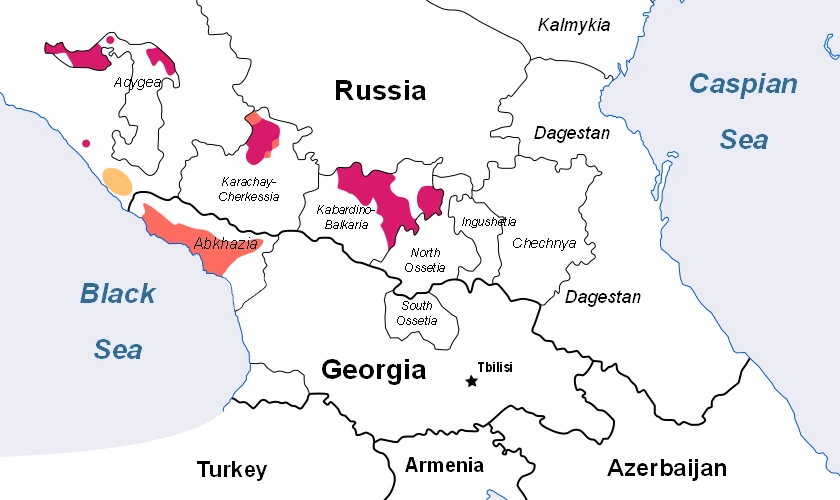
- Kabardian (East Circassian, also called Kabardian-Circassian; in Kabardian къэбэрдейбзэ, or simply адыгэбзэ): official in Kabardino-Balkaria and Karachay-Cherkessia, and spoken across the diaspora. About 1.9 million speakers.
- Adyghe (West Circassian; кӀахыбзэ, or адыгабзэ): one of the two official languages of Adygea, and mainly spoken in the diaspora in Turkey, Jordan, Syria and Israel. About 600,000 speakers. Its literary standard is based mostly on the Temirgoy dialect.
More on the name in What does Adyghe mean?
How different are they?
Different enough to matter, close enough to talk. The two are reciprocally intelligible: speakers can communicate, “with varying degrees of efficiency”, as one reference puts it. Everyday talk works better than unfamiliar topics, and exposure helps. That is also why linguists disagree on what to call them: some say two languages, some two dialects of one Circassian language. In Russia each has its own literary standard, alphabet and official status in its republic.
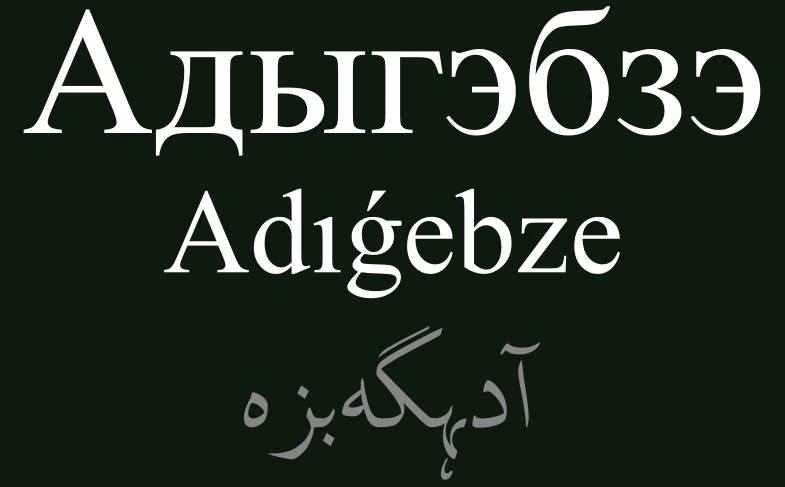
Key differences
Sounds
This is the biggest difference. Adyghe has more consonants (50 to 60 depending on the dialect) and is phonologically more complex than Kabardian: it has retroflex consonants and their rounded forms, which Kabardian lacks. Kabardian, for its part, is one of very few languages that distinguishes ejective affricates from ejective fricatives. Both have just three phonemic vowels. The alphabets show it: the app teaches 66 Adyghe letters and 60 Kabardian ones, and Дзу, Жъ, Жъу, ПIу, ТIу, Цу, Чъ, Шъ, Шъу, ШI, ШIу exist only in Adyghe, while ФI, ЩI, Ху, Кхъ, Кхъу exist only in Kabardian. Hear every letter in the Circassian alphabet guide.
Words
Much of the core vocabulary is shared, but many everyday words are different, and others differ by a sound or two. Thirteen pairs from the app’s two courses, with the app’s audio:
| English | Kabardian | Adyghe |
|---|---|---|
| good day | Уи махуэ фIыуэWi makhwe f'ywe | Уимафэ шIу!Wimafe sh'u! |
| thank you | УпсэуUpsew | ТхьауегъэпсэуThaweyeghepsey |
| goodbye | ФIыкIэF'yk'e | ХъяркIэKhyark'e |
| yes | нтIэnt'e | арыarə |
| no | хьэуэh'ewe | хьауhaw |
| mother | анэane | нанэnane |
| guest | хьэщIэh'eshch'e | хьакIэhak'e |
| mountain | бгыbgy | къушъхьэqwshshhe |
| river | псыежэхpsyezhekh | псыхъоpsəkho |
| chicken | джэдdzhed | чэтыchetə |
| village | къуажэqwazhe | къуаджэqwaje |
| strong | лъэщleshch | лъэшlhesh |
| food | шхынshkhyn | шхыныshkhənə |
Grammar
In grammar the two follow the same pattern: like all Northwest Caucasian languages, both are ergative, put the verb at the end of the sentence, and build long words from many small parts.
Historical background
Kabardian is the language of the eastern Circassian groups, Adyghe of the western ones. The separation became official in the Soviet period, when each got its own written standard: first a Latin alphabet (Kabardian was widely written in Latin in 1923–1936, Adyghe in 1927–1938), then a Cyrillic one (Kabardian from 1936, Adyghe from 1938). Since then each has had its own spelling, schoolbooks and dictionaries.
What they share
- The same family: the Northwest Caucasian languages, with Abkhaz, Abaza and the extinct Ubykh.
- The same script: Cyrillic with the palochka (Ӏ) and letter combinations.
- The same structure: few vowels, many consonants, ergative grammar.
- The same culture: the words of Habze, hospitality and family, and the proverbs that carry them. Habze, the Circassian code
- The same status: UNESCO lists Circassian, Kabardian and Adyghe alike, as vulnerable.
Sometimes the same word means different things. In Adyghe нанэ is “mother”, while in Kabardian the same нанэ is “grandmother”.
Which one should you learn?
Follow your family. If your family is Kabardian, learn Kabardian. If your roots are in Adygea, or your family is Shapsug, Abzakh, Bzhedug or Hatuqay, learn Adyghe. With no family connection either works: Kabardian has more speakers, Adyghe is widely spoken in the diaspora. Whichever you choose, start with the alphabet and the first greetings: learn Kabardian or learn Adyghe, and see how to learn Circassian.
Free on iPhone & Android
Learn Circassian a few minutes a day
Short Kabardian or Adyghe lessons with audio, an alphabet course and an AI tutor. The first lessons work without an account.

4.9 on the App Store 53,000+ people in 100+ countries
Kabardian vs Adyghe: questions
Are Kabardian and Adyghe the same language?
They are the two literary forms of Circassian. Some linguists treat them as dialects of one language, others as two closely related languages.
Can Kabardian and Adyghe speakers understand each other?
Yes, with more or less effort: they are reciprocally intelligible, especially on everyday topics.
What is the biggest difference?
The sounds. Adyghe has more consonants, including retroflex ones that Kabardian lacks, so its alphabet is longer (66 letters in the app against 60).
Which has more speakers?
Kabardian, with about 1.9 million speakers against about 600,000 for Adyghe.
Where is each spoken?
Kabardian is official in Kabardino-Balkaria and Karachay-Cherkessia; Adyghe in Adygea. Both are spoken across the diaspora, Adyghe above all in Turkey, Jordan, Syria and Israel.
Which should I learn first?
The one your family speaks. Without a family connection either works; the app teaches both, each in its own course.
Sources
- Wikipedia (English), “Circassian languages”. en.wikipedia.org/wiki/Circassian_languages
- Wikipedia (English), “Kabardian language”. en.wikipedia.org/wiki/Kabardian_language
- Wikipedia (English), “Adyghe language”. en.wikipedia.org/wiki/Adyghe_language
- Wikipedia (English), “Adyghe phonology”. en.wikipedia.org/wiki/Adyghe_phonology
- Wikipedia (Russian), «Адыгейская письменность», «Кабардино-черкесская письменность». ru.wikipedia.org/wiki/%D0%90%D0%B4%D1%8B%D0%B3%D0%B5%D0%B9%D1%81%D0%BA
- Word pairs, alphabets and audio: the Circassian App’s Kabardian and Adyghe courses (version 5.8), checked October 5, 2026.
Learn Circassian in a few minutes a day
Short lessons in Kabardian or Adyghe. Hear how the words sound, learn to read the alphabet, then practice with an AI tutor who replies in Circassian.
Download free53,000+ people in 100+ countries
