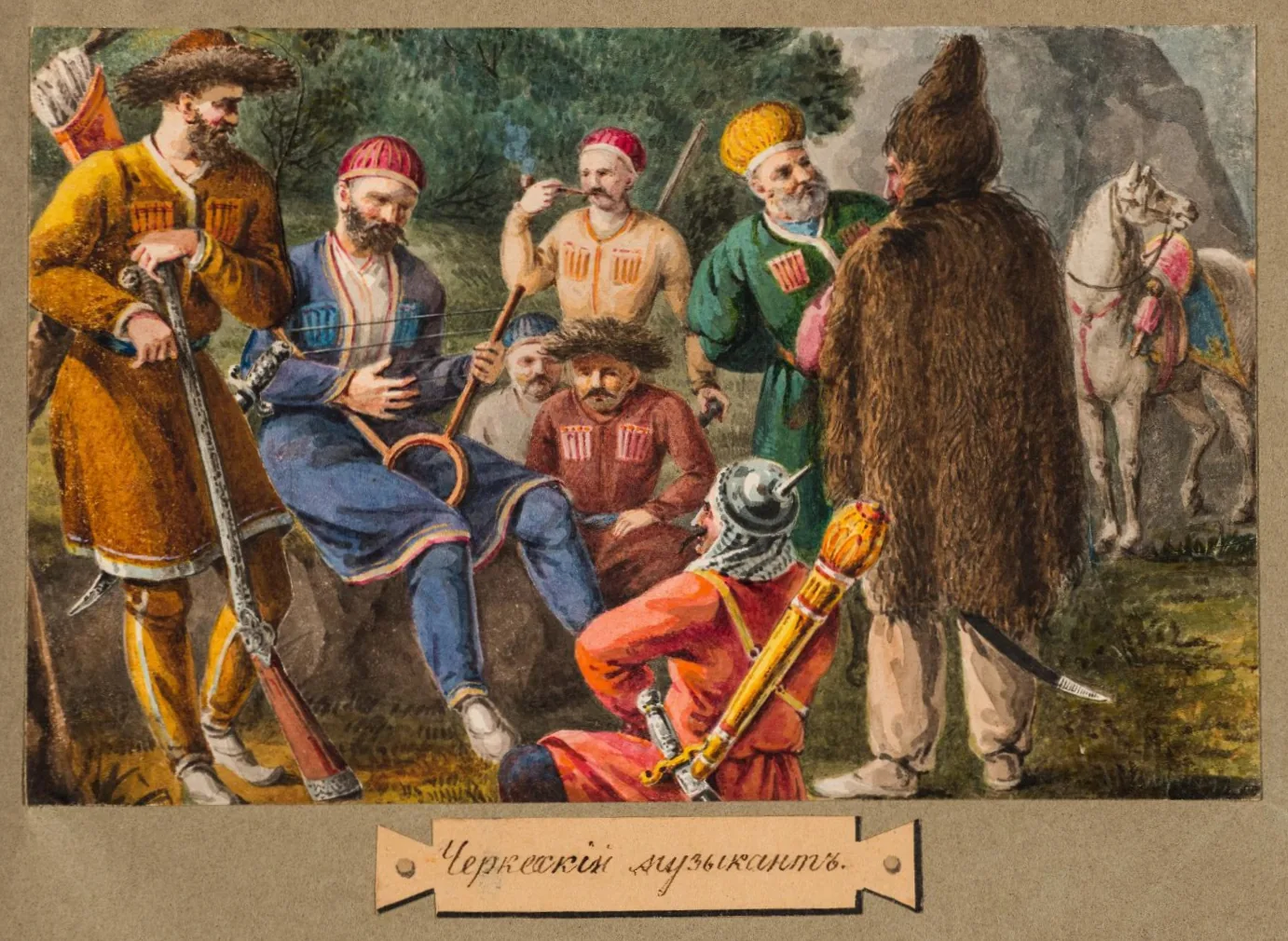
Traditional Circassian music was played on the shichepshin, a fiddle with strings of horsehair, the kamyl flute and the pkhachich, a wooden rattle; from the second half of the 19th century the accordion, the pshine, became the favourite. The songs range from Nart epics and laments for heroes to work songs and lullabies, and the music is inseparable from Circassian dance.
Music is the heartbeat of Circassian culture. It drives the dance, carries the old epics and laments, and still fills every wedding. For centuries singers and wandering musicians were among the main keepers of Circassian history and values.
Traditional Circassian instruments
Shichepshin (шыкIэпшынэ in Kabardian, шыкIэпщын in Adyghe) is the Circassian bowed fiddle. Its name joins the words for horse, tail and instrument, and its two or three strings are indeed twisted from horsehair. Body, neck and round head are carved from a single piece of wood such as pear, lime or maple, and the player holds it upright, resting it on the knee. The sound is soft and muted. The player was usually a singer and storyteller too, accompanying songs alone or with the kamyl and the pkhachich. Popular until the end of the 19th century, it became rare in the 20th, but it is being revived: in 2005 the first students of the Adyghe artist and music teacher Zamudin Guchev founded the ensemble Жъыу, which plays it today.
Pshine (пшынэ in Kabardian, пщынэ in Adyghe) is the accordion. It spread widely among Circassians from the second half of the 19th century, and some of today’s best-known Circassian folk musicians, such as Aslan Tlebzu, are accordionists.
Pkhachich (пхъэцIыч in Kabardian, пхъэкIыч in Adyghe) is a wooden rattle: three, five or seven plates of dried hardwood such as boxwood, ash, chestnut or hornbeam, loosely tied at one end to a plate with a handle. Shaken, it gives a sharp click that marks the rhythm of songs and dances, with the kamyl, the shichepshin or the accordion, and with the accordion two are often used. Today it is a favourite souvenir in Adygea and Kabardino-Balkaria.
Kamyl, also called bzhami (бжьамий in Kabardian), is an end-blown flute. Its name means reed, which suggests it was first made of reed; later it was usually made from a gun barrel. It is about 70 cm long, with three finger holes near the bottom. Shepherds played it, and it accompanied young people’s round dances.
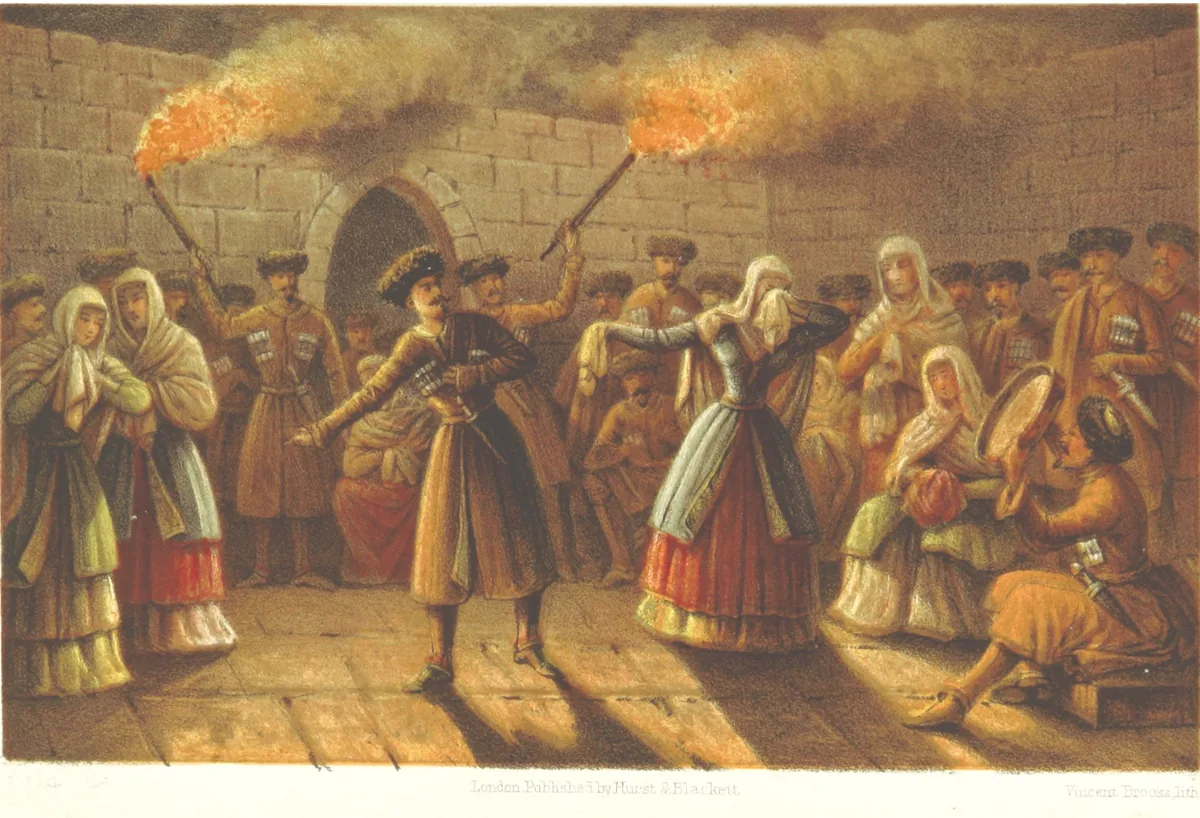
There was also the plucked apepshin, and drums: a drummer sits at the edge of the dance in the 1865 lithograph below. How each instrument is built, with its dimensions and tuning, is on our page about Circassian musical instruments.
Music and dance
Circassian music and dance cannot be separated: the melody sets the dance, its tempo and its mood. There are three main families of dances: the Wuj circle dances, the slow partner dance Qafa and the fast Islamey.
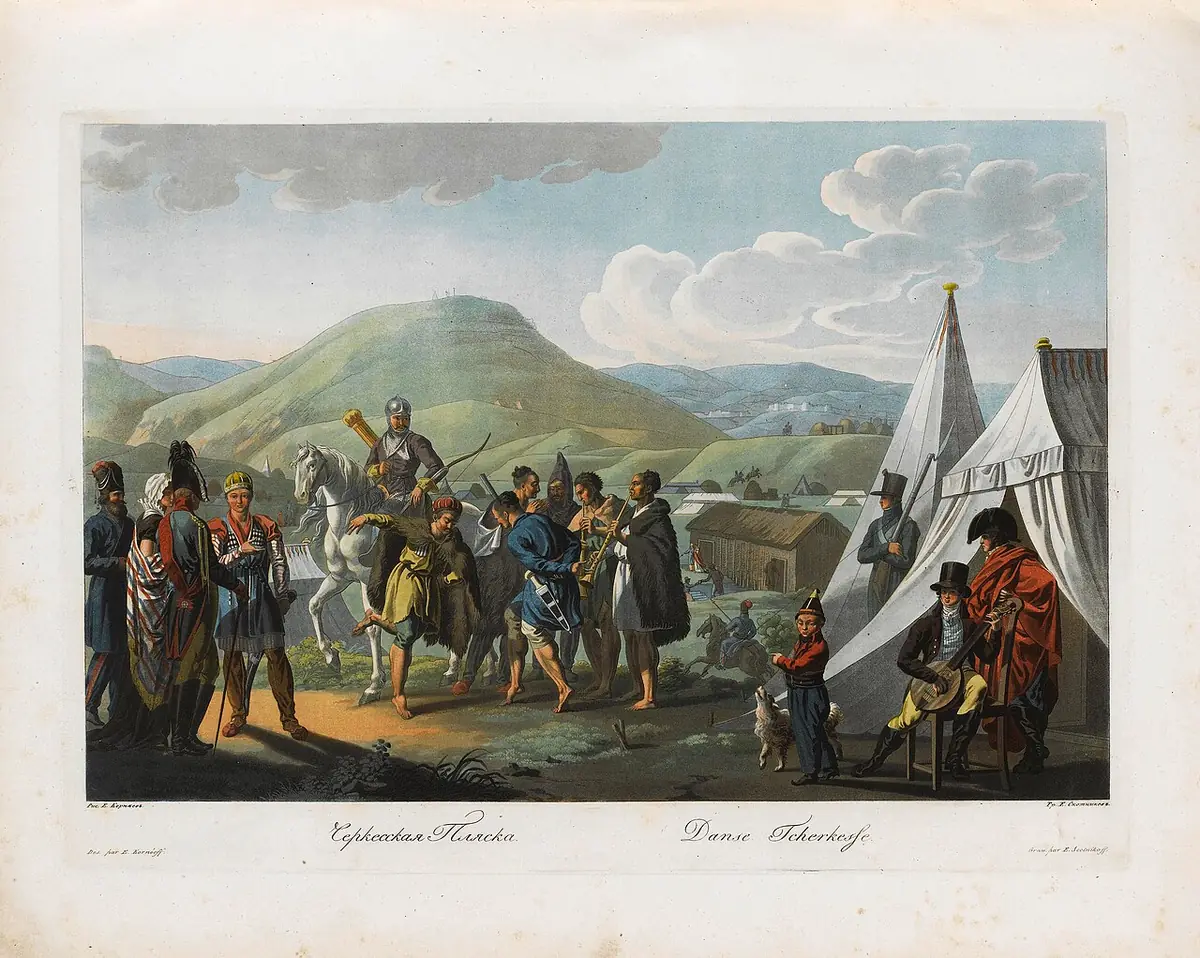
At a джэгу, a dance party, the musician was never just in the background. In the past the leading figure was often the джэгуакIуэ, a wandering performer who, as the Kabardian dictionary puts it, directed the dances, joked, improvised verses and played music, and the traditional music survived largely thanks to such wandering musicians.
The words to dance by, from lesson 29 of the audio course. Tap to hear each in both dialects:
| Meaning | Kabardian | Adyghe |
|---|---|---|
| music | макъамэmaqame | музыкэmuzyke |
| song | уэрэдwered | орэдored |
| to dance | къафэнqafen | къэшъонqeshon |
| Let’s dance! | Еуэ дыкъэфэнщ!Yewe dyqefenshch! | НекIо, тыкъэшъощт!Nyek'o, tyqeshoshcht! |
| I like to dance. | Къафэн сфIэфIщ.Qafen sf'ef'shch. | Къэшъонэу сикIас.Qeshoneu sik'as. |
Circassian folk songs
- Heroic songs and laments. Songs tell of heroes (лIыхъужь in Kabardian) and historical events, and laments for heroes are called гъыбзэ, a word the Kabardian dictionary gives both for a ritual lament and for a genre of old epic songs.
- Toasts and good wishes. A хъуэхъу is a toast or good wish, said at weddings, feasts and gatherings.
- Work songs. There were songs for ploughmen, mowers, ox drivers at threshing, women carding wool, and for weeding the fields.
- Ritual and family songs. Songs to the patrons of the forest, songs to call the rain and New Year songs; and in the family, wedding songs and lullabies.
The Nart sagas in music
The Nart sagas are the great epic of the Circassians, shared in different versions with other peoples of the North Caucasus. Most of the Adyghe Nart texts that survive were written down in poetic form, as songs with their own melodies. Their heroes include Sosruko, born from a stone in every version, and Satanaya, a figure of beauty and wisdom. A singer of the old epics often accompanied himself on the shichepshin.
Modern Circassian music
Today Circassian music lives on stage, in studios and online. In the Caucasus, state ensembles carry the dances and melodies: Kabardinka in Kabardino-Balkaria and Nalmes, founded in 1936, in Adygea. Singers such as Cherim Nakhushev, Murat Tkhagalegov and Zaur Tutov sing in Circassian, and the accordionist Aslan Tlebzu is one of the best-known Circassian folk musicians. Since 2013 the label ORED Recordings, founded by the Circassian musicians Bulat Khalilov and Timur Kodzoko, has been recording traditional music at gatherings and family celebrations.
Circassian music reached classical music too: Balakirev’s piano piece Islamey (1869) was built on a dance tune a Circassian prince played for him. Where to listen to all of them: Circassian songs and artists.
The words of the songs, toasts and dance calls are in Kabardian and Adyghe, and knowing the language unlocks them. The Circassian App teaches both: start with how to learn Circassian.
Free on iPhone & Android
Circassian language and culture, in one app
Kabardian and Adyghe lessons, Habze culture lessons, a library of books, films and music, and Circassians from around the world to talk to.

4.9 on the App Store 53,000+ people in 100+ countries
Circassian music: questions
What are the traditional Circassian instruments?
The shichepshin (a bowed fiddle with horsehair strings), the kamyl or bzhami (a flute), the pkhachich (a wooden rattle) and the plucked apepshin; since the second half of the 19th century the accordion, the pshine.
What is a shichepshin?
A bowed fiddle carved from one piece of wood, with two or three strings of twisted horsehair, played upright on the knee. Its name means horse, tail and instrument.
What is the pshine?
The accordion (пшынэ in Kabardian, пщынэ in Adyghe). It spread from the second half of the 19th century, and many well-known Circassian folk musicians today play it.
What kinds of Circassian songs are there?
Nart epics, heroic songs and laments (гъыбзэ), work songs, ritual songs, wedding songs and lullabies.
Who are well-known Circassian musicians today?
Among others Cherim Nakhushev, Murat Tkhagalegov, Zaur Tutov and the accordionist Aslan Tlebzu; see Circassian songs and artists for where to listen.
Sources
- Wikipedia (Russian), «Шичепшин». ru.wikipedia.org/wiki/Шичепшин
- Wikipedia (Russian), «Пхачич». ru.wikipedia.org/wiki/Пхачич
- Wikipedia (Russian), «Камыль». ru.wikipedia.org/wiki/Камыль
- Wikipedia (Russian), «Адыги». ru.wikipedia.org/wiki/Адыги
- Wikipedia (Russian), «Нартский эпос». ru.wikipedia.org/wiki/Нартский_эпос
- Wikipedia (English), “Circassian dance”. en.wikipedia.org/wiki/Circassian_dance
- Apazhev M. L., Kokov J. N. Kabardian-Circassian-Russian dictionary. Nalchik: Elbrus, 2008, pp. 43, 80, 93, 312, 377, 551, 576.
- The Circassian App: audio course lesson 29 (Kabardian and Adyghe) and its Adyghe dictionary.
- Artists and recordings: see the sources on Circassian songs and artists.
Want more like this?
The app has 64 short lessons on Circassian traditions, including four on music and dance. Plus a course in Kabardian or Adyghe to learn the language behind them.
Download free53,000+ people in 100+ countries
