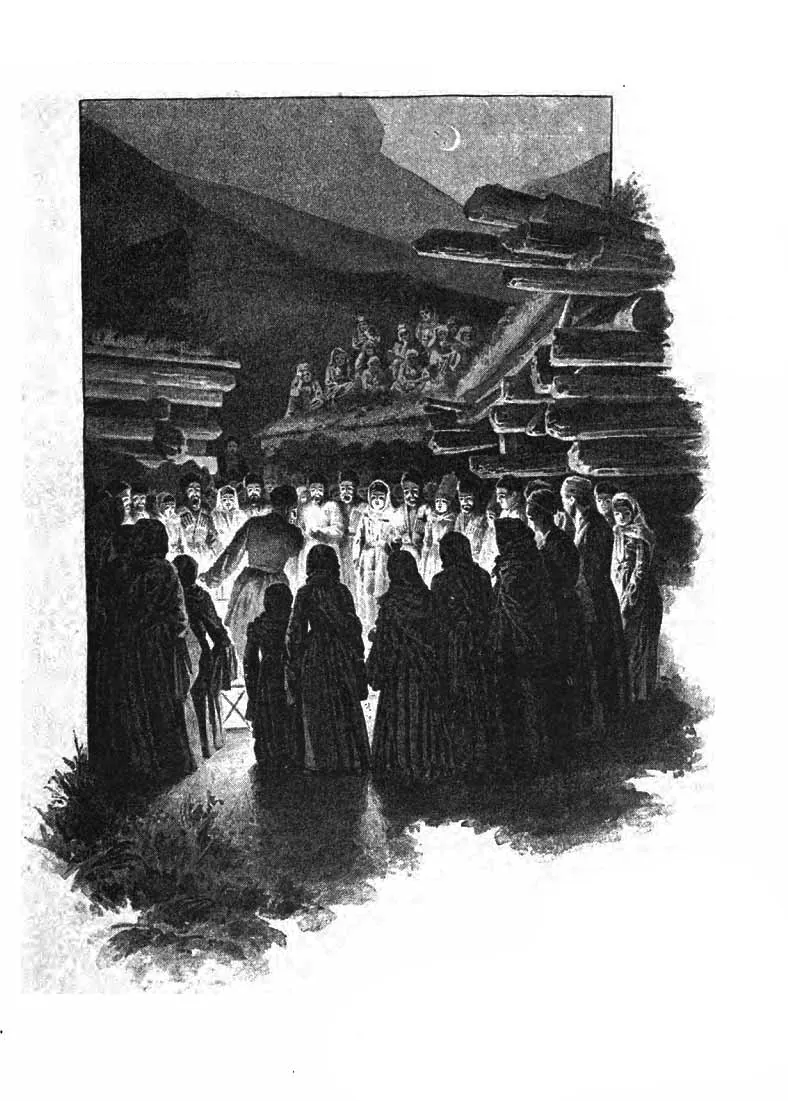
Wuj is the name for a group of Circassian mass circle dances that traditionally close a celebration. Dancers move in a circle, usually counter-clockwise. It is one of the three main kinds of Circassian dance, with the slow Qafa and the fast Islamey.
The three main Circassian dances: Wuj · Qafa · Islamey. More: the guide to Circassian dance.
What Wuj is
Wuj is not one dance but a family of circle dances. They are generally danced in a circle, often moving counter-clockwise, and traditionally they bring a Circassian celebration to its end. The name is usually explained as meaning “to move forward” or “to advance”. Wuj dances fall into two broad groups: ceremonial dances, which became social dances, and older historical and ritual ones.
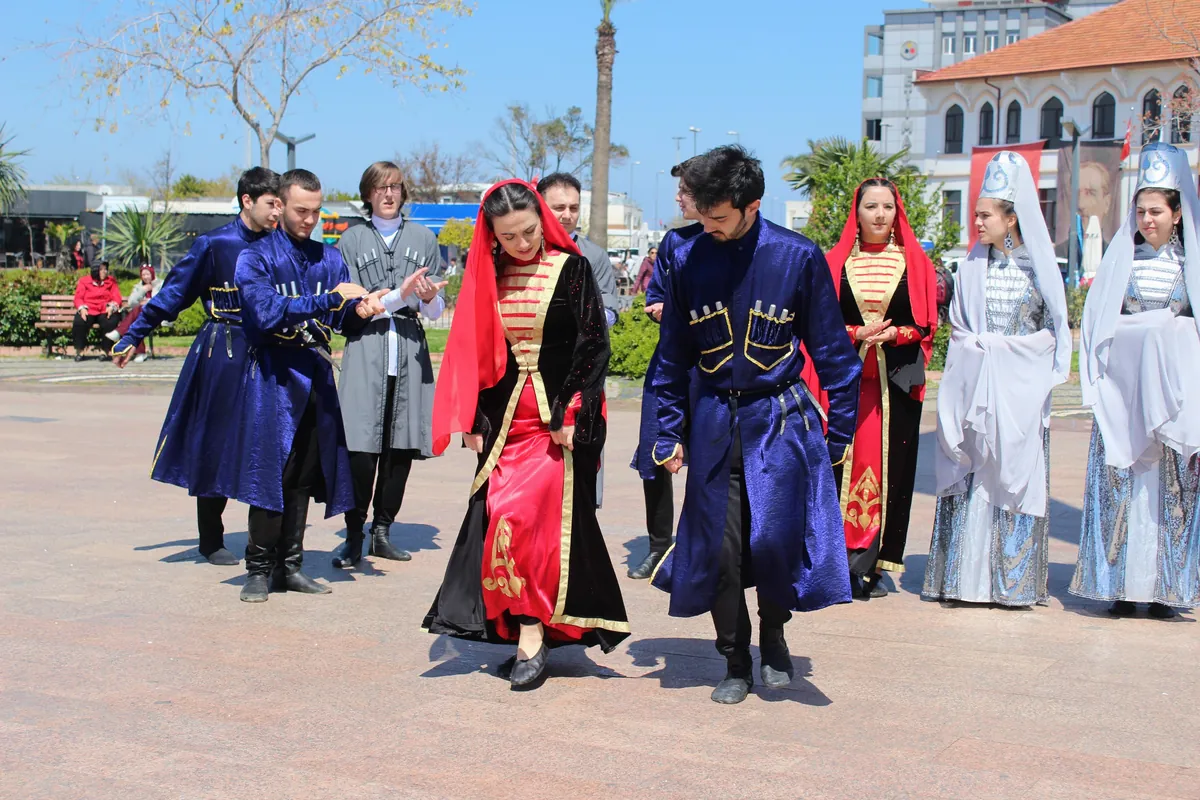
Wedding and social Wuj
The ceremonial Wuj dances are about etiquette and about young men and women meeting in public:
- Wuj-Khesh, “the invitation”, danced at weddings and gatherings. It was a main way for young people to communicate in public; the name refers to the khatiyako leading the dancers into the circle.
- Wuj-Pukh, a wedding dance. In Kabardian versions the name also refers to a figure in which partners change.
- Nekhush-Wuj, the “morning Wuj”, danced as the festivities come to an end.
Pair Wuj and horse Wuj
Wuj Turitu, the “pair Wuj”, is remembered as the most democratic of the dances, because it let commoners dance with aristocrats. Unusually, partners could touch hands, fingers intertwined, and exchange a few words. Shigha-Wuj, the “stallion’s Wuj”, is a fast dance with its own music, in which the feet imitate a trotting horse.
The old ritual dances
Some Wuj dances once had religious or mythological meaning:
- Wuj-Khurey, the “circular Wuj”: the dancers move rhythmically from left to right with stamping feet, a solar symbol. It was the high point of a festival and could go on for hours.
- Thashkho-Wuj, the “Wuj of the Great God”, danced at old religious ceremonies to mythological hymns.
- Shible-Wuj, the “Wuj of the god of thunder”, danced when it thundered or when someone was struck by lightning; among the Ubykh and the Shapsugs it had its own accented foot taps.
- Thaghelej-Wuj, danced for the deity of farming and plenty to bring a good harvest.
Wuj is still danced at Circassian weddings and gatherings around the world. In the United States, for example, Circassian families dance the Wij, Qafa and Islamey at weddings and cultural events.
Free on iPhone & Android
Circassian language and culture, in one app
Kabardian and Adyghe lessons, Habze culture lessons, a library of books, films and music, and Circassians from around the world to talk to.

4.9 on the App Store 50,000+ people in 100+ countries
Wuj: questions
What is the Wuj dance?
A family of Circassian circle dances that traditionally close a celebration, usually danced moving counter-clockwise.
When is Wuj danced?
At weddings, gatherings and festivals, traditionally at the end. Some forms, like the morning Wuj, belong to the very end of the festivities.
What does Wuj mean?
The name is usually explained as “to move forward” or “to advance”.
What is the pair Wuj?
Wuj Turitu, remembered as the most democratic dance: commoners could dance with aristocrats, and partners could touch hands and talk briefly.
What are the other main Circassian dances?
The slow, dignified Qafa and the fast Islamey.
Sources
- Wikipedia (English), “Circassian dance”. en.wikipedia.org/wiki/Circassian_dance
- Wikipedia (English), “Circassian Americans”. en.wikipedia.org/wiki/Circassian_Americans
Want more like this?
The app has 64 short lessons on Circassian traditions, including four on music and dance. Plus a course in Kabardian or Adyghe to learn the language behind them.
Download free50,000+ people in 100+ countries
