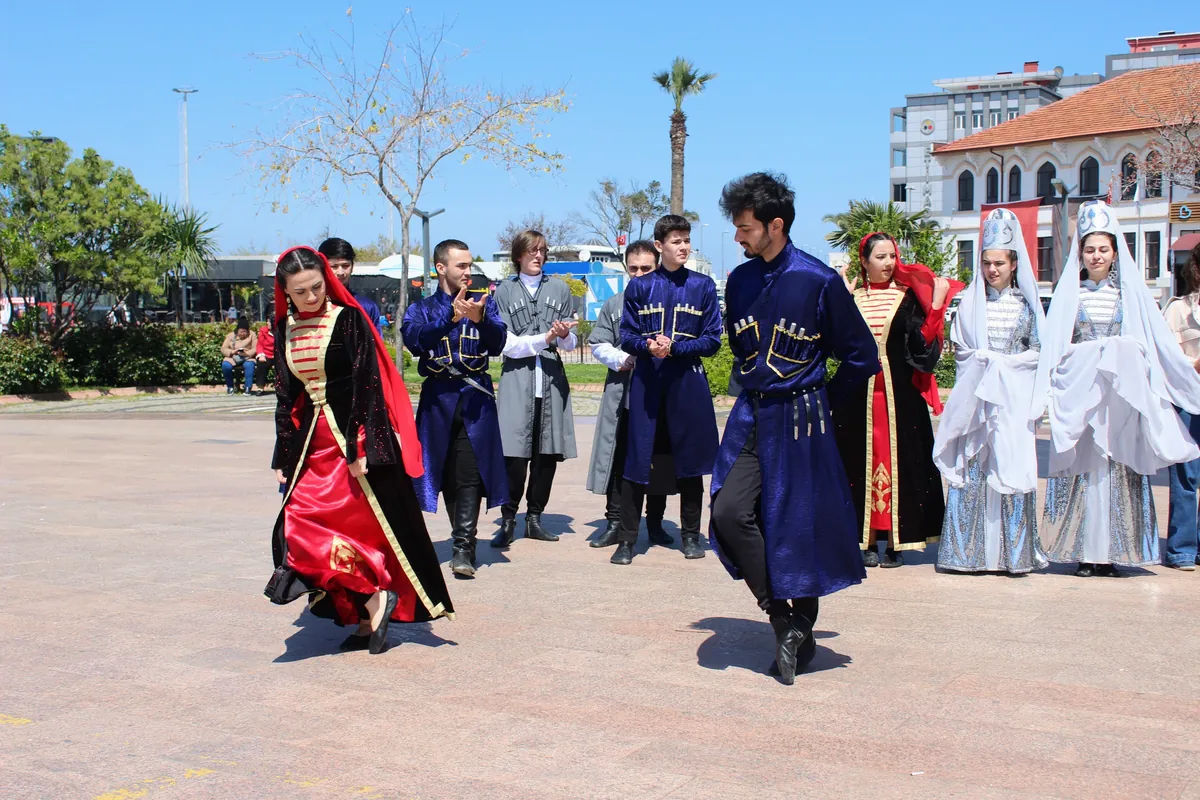
Circassian dance comes in three main families: the Wuj circle dances, the slow, dignified Qafa and the fast Islamey. The men dance on the tips of their toes in soft leather boots, the women glide without moving their heads, and partners never touch. The dances evoke combat and courtship, and in the diaspora they are one of the strongest ways Circassians keep their culture alive.
If you have ever seen Circassian dance, you know it is like nothing else. The men rise onto their toes with explosive precision, the women seem to float, and the whole thing is controlled, restrained and elegant. It is more than a performance: the dances evoke combat and courtship, and they carry the code of conduct the Circassians call Habze.
The role of dance in Circassian culture
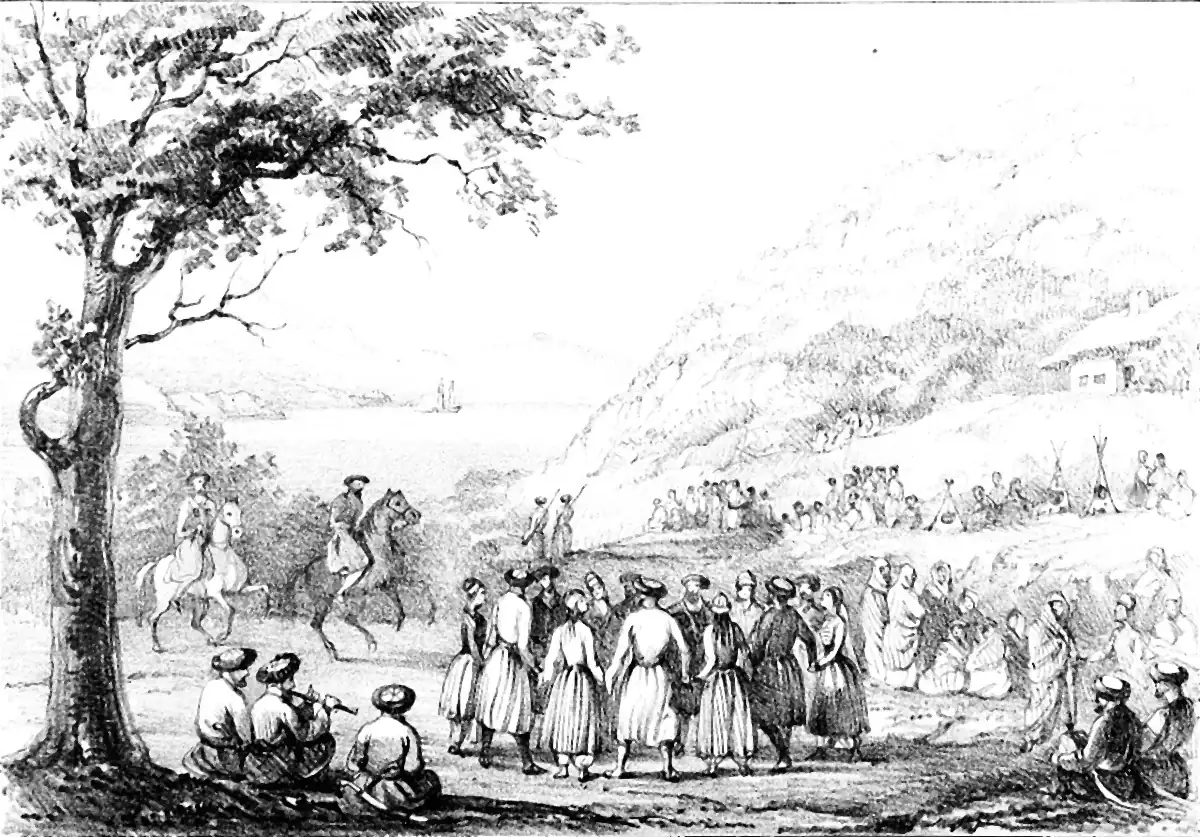
Dance has always been at the centre of Circassian social life. The джэгу, the dance party, was where young men and women could meet and get to know each other, and Habze set how they behaved toward each other. It was often led by the джэгуакIуэ, a travelling performer who, as the Kabardian dictionary puts it, was dance master, jester, improviser and musician in one. Dancing well still matters: it counts for a person’s standing, especially when it comes to marriage.
Main dance styles
Circassian dances are usually divided into three families:
Wuj удж
Mass circle dances that close a celebration, usually moving counter-clockwise; the name means “to move forward”. One, Wuj Turitu, was the most democratic of all: commoners could dance with aristocrats, and partners could touch hands.
Qafa къафэ
The slow, dignified pair dance, once called the “princely dance”. Dancers glide on their half-toes and never touch; partners first pass each other on the left to present themselves. Western Circassians call this style Zafaku.
Islamey ислъэмей
The fast “dance-play”, first a pair dance for lovers, named after a Kabardian village. It shows an eagle and a she-eagle, and the men roll up their sleeves before they start. The Kabardian Islamey is stately; the Bzhedug Islamey of Adygea is faster.
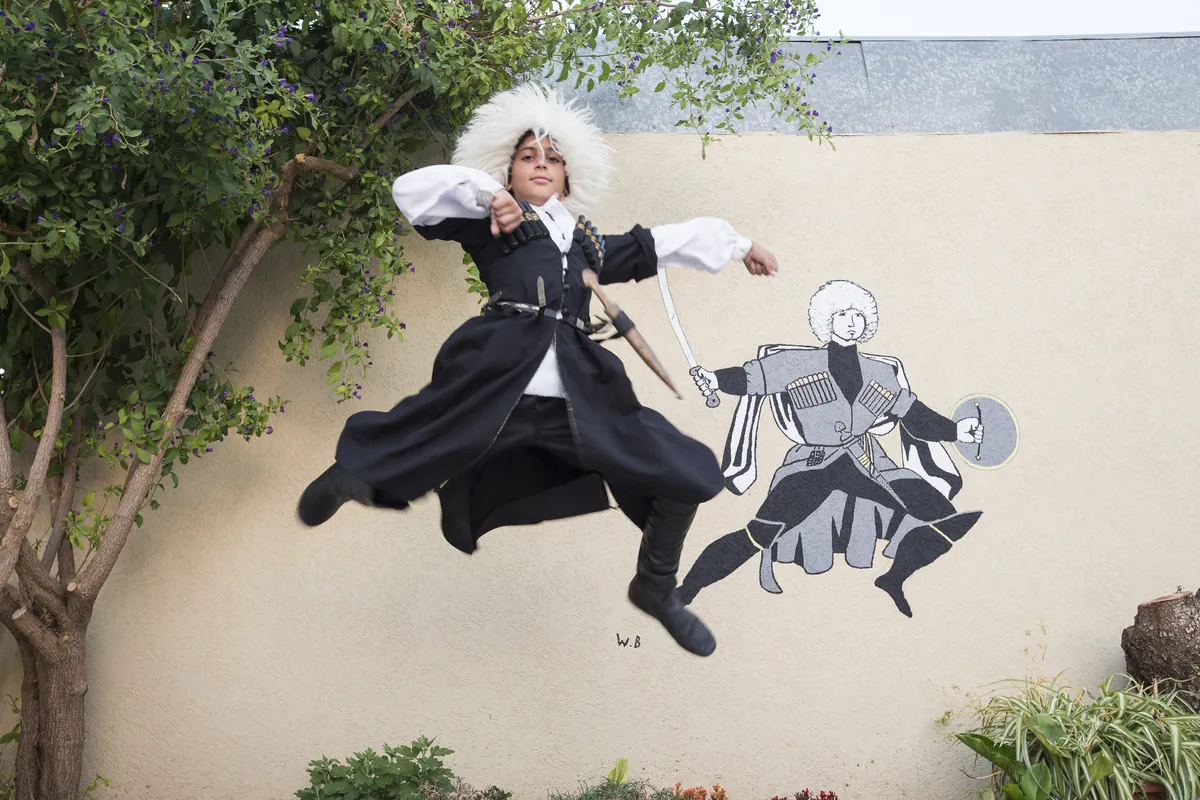
Besides these there are the fast solo improvisations, among them Laparisa (the Kabardian лъапэрисэ, from “to dance on the toes”), the Azheqafa with its satirical goat mask, and a dagger dance that grew out of an old boys’ game of throwing daggers into the floor.
The Habze of dance
The rules of Habze show in every dance. In the Qafa partners keep a respectful distance and never touch, and emotion is shown through restraint rather than stunts; even the opening, when the partners pass each other on the left, is a formal greeting. The competition dances, which 19th-century writers called Lezginka or Islamey, are disciplined and austere by design: they avoid open displays of emotion and served young people as training in endurance, will and character.
More on the code itself in What is Habze, and on the clothes the dancers wear in Circassian clothing.
Men’s movement
The men dance on the tips of their toes in special soft leather boots, the summit of the art and most of all in the Islamey. In the competition dances one dancer leaps into the centre of the circle and the next follows, often with hands held behind the back, with turned-in feet and small, quick leaps. Many movements come from a warrior’s life: one figure shows dodging a sword stroke, and the arms mimic the use of weapons, the gait of a horse or the flight of an eagle. On stage the men wear the black cherkeska with cartridge holders across the chest, often with a dagger, and a dagger or sword can be part of the dance.
Women’s movement
The women glide across the floor so smoothly that they seem to float, without moving the head or the upper body. In the Qafa they move on their half-toes in the slow, gliding Qafa step, and in one old form, the Zaqo Qafa, a single woman danced alone to show her grace to the community. Some records tell of toe-dancing contests between young men and young women that lasted up to thirty minutes.
60-second lesson
Five words for the dance
To dance, a song, and three words for the body: head, hand and foot. Tap a word to hear it in Kabardian (East) and Adyghe (West), then take the quiz: the app’s own question, five rounds.
The quiz needs JavaScript.
In the app, questions like these are in every lesson, and the words you get wrong come back for review sooner.
All the body words, in both dialects, with example sentences: Body parts in Circassian.
Circassian dance today
The dance is one of the ways the diaspora keeps its culture alive. In Turkey it is widely known as “Kafkas”, from Kafkasya, the Caucasus; in the Circassian villages of Israel children learn it at school; in Jordan an old form of the Qafa, the Qafa Quansha, has been kept (Circassians in Jordan); and in the United States the Qafa, the Wuj and the Islamey are danced at weddings and cultural events. In the Caucasus, state ensembles carry it on stage: Kabardinka in Kabardino-Balkaria, which grew out of a 1933 arts studio and took its name in 1965, and Nalmes, founded in 1936, in Adygea.
Circassian dance also shaped its neighbours, most of all the Cossack dance, and its music reached the concert hall: Balakirev’s piano fantasy Islamey (1869) is built on the Islamey tune.
Learning Circassian dance
The best way to learn is in person, in a community dance group, where you pick up posture, timing and the etiquette that no video can teach. The slow Qafa is the gentlest start; the men’s toe work and the fast Islamey take real strength and years of practice, and the women’s smooth gliding step is harder than it looks.
Dance and language go together: the dance calls, the songs and the names of the dances are all Circassian. The words for a dance party, from lesson 29 of the audio course, in both dialects:
| Meaning | Kabardian | Adyghe |
|---|---|---|
| to dance | къафэнqafen | къэшъонqeshon |
| Let’s dance! | Еуэ дыкъэфэнщ!Yewe dyqefenshch! | НекIо, тыкъэшъощт!Nyek'o, tyqeshoshcht! |
| Do you like to dance? | Укъэфэн уфIэфI?Uqefen uf'ef'? | Укъэшъонэу уикIаса?Uqeshoneu wik'asa? |
| I like to dance. | Къафэн сфIэфIщ.Qafen sf'ef'shch. | Къэшъонэу сикIас.Qeshoneu sik'as. |
More on the music behind the dances in Circassian music and where to listen; and for the Scottish dance that shares the name, see the Circassian circle.
Free on iPhone & Android
Circassian language and culture, in one app
Kabardian and Adyghe lessons, Habze culture lessons, a library of books, films and music, and Circassians from around the world to talk to.

4.9 on the App Store 53,000+ people in 100+ countries
Circassian dance: questions
What are the main Circassian dances?
Three families: the Wuj circle dances, the slow pair dance Qafa and the fast Islamey. There are also fast solo improvisations such as Laparisa.
Why do Circassian men dance on their toes?
The dance on the toes, in soft leather boots, is the summit of the art and a test of strength and control; it is used most in the Islamey and in competition dances.
Do partners touch in Circassian dance?
Not in the Qafa: partners keep a respectful distance. One old circle dance, Wuj Turitu, was unusual because partners could touch hands.
What is the Circassian dance called in Turkey?
Kafkas, from Kafkasya, the Turkish name of the Caucasus.
What is the Islamey?
A fast Circassian dance, first a pair dance for lovers, named after a Kabardian village. Its tune inspired Balakirev’s famous piano fantasy Islamey (1869).
How can I learn Circassian dance?
Join a community dance group if you can; start with the slow Qafa. Learning the language helps too: the dance calls and songs are in Circassian.
Sources
- Wikipedia (English), “Circassian dance”. en.wikipedia.org/wiki/Circassian_dance
- Wikipedia (English), “Adyghe Khabze”. en.wikipedia.org/wiki/Adyghe_Khabze
- Wikipedia (English), “Circassian Americans”. en.wikipedia.org/wiki/Circassian_Americans
- Wikipedia (Russian), «Кабардинка (ансамбль)». ru.wikipedia.org/wiki/Кабардинка_(ансамбль)
- Wikipedia (Russian), «Нальмэс (ансамбль)». ru.wikipedia.org/wiki/Нальмэс_(ансамбль)
- Apazhev M. L., Kokov J. N. Kabardian-Circassian-Russian dictionary. Nalchik: Elbrus, 2008, pp. 93, 178, 222, 298, 449.
- The Circassian App: audio course lesson 29 (Kabardian and Adyghe).
Want more like this?
The app has 64 short lessons on Circassian traditions, including four on music and dance. Plus a course in Kabardian or Adyghe to learn the language behind them.
Download free53,000+ people in 100+ countries
