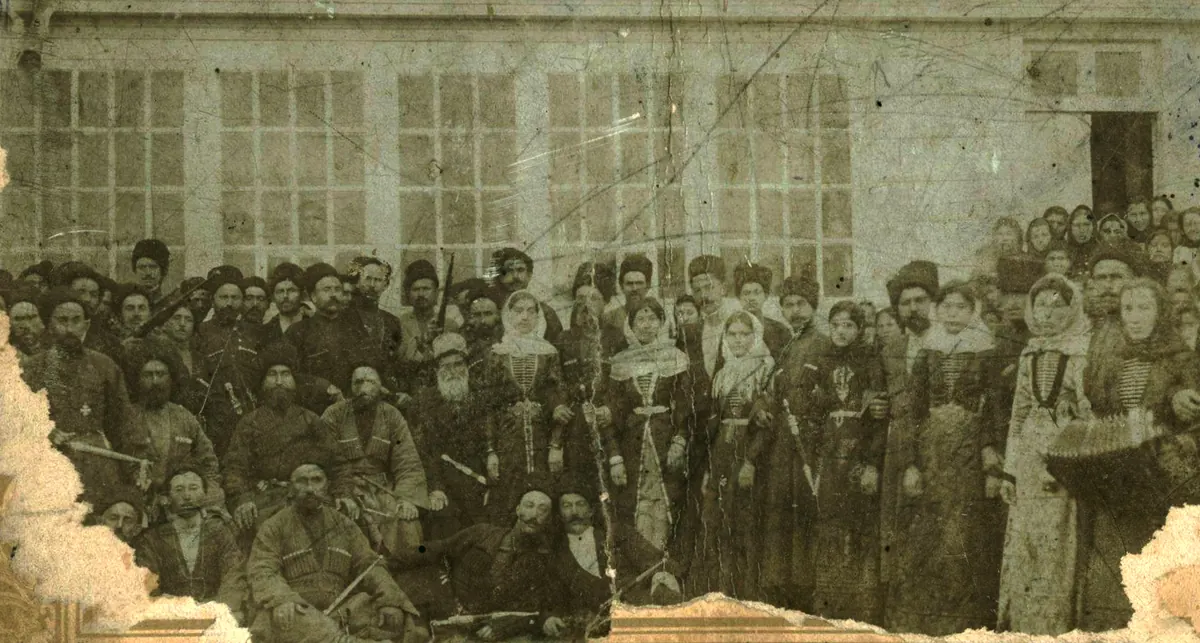
In Kabardian a wedding is a хьэгъуэлIыгъуэ, and the heart of it is the нысашэ: bringing the bride from her parents’ home to the groom’s, and the celebration that goes with it. Circassian wedding traditions are famous for how much happens around that journey, from the matchmakers’ first visit to the bride’s first stitches in her new home.
This page follows the old Kabardian wedding step by step, using the words recorded in the Kabardino-Cherkess–Russian dictionary (Nalchik, 2008), which describes each custom in its entries. Customs differed between Circassian groups, villages and families, and many are no longer kept, so read this as the tradition the dictionary records, not as a rule for every wedding today.
Matchmaking
Marriage began with matchmakers. The dictionary has several words for them: лъыхъу, a matchmaker or the matchmaking itself, and лIыкIуэ, a word that also means an intermediary or envoy. The first meeting between the groom’s matchmakers and the bride’s relatives had its own name, зэхэщIэ. Before the wedding the bride’s relatives could also come to look over the groom’s house and household, a custom called унаплъэ.
The groom himself is a псэлъыхъу, which the dictionary explains as literally “one who seeks a soul”. In the past the groom’s side paid a bride price, уасэ, a word that today simply means “price”. The language even marries people differently: a woman дэкIуэн, “goes with” someone, while a man къэшэн, “brings” a wife home.
Taking the bride
Leaving her parents’ home was full of small, playful payments. The groom’s side paid a symbolic sum, the куэбжэдэнэ, to take the bride out through the gate of her parents’ yard. In another Kabardian rite they paid the eldest woman among the bride’s relatives, and only then did she stand up and let them lead the bride away.
On the road, someone might block the wedding procession in jest; by old custom he was offered a cup or a drinking horn, the гъуэгубжьэ. Near the groom’s home the procession was met with food and drink, the пехьэжьэ. The bride did not go straight into the groom’s house either: she was first taken to the home of one of his friends or relatives, the тешэрэщ, and stayed there for a while.
The groom who stays away
One of the best-known Circassian wedding customs is that the groom keeps away from his own wedding. The dictionary records it in two places: for the time of the wedding the groom is called a щауэ, and one meaning of къан is a groom staying at the house of a relative or friend until the wedding is over. His friends threw him a feast there, and a best man, the щауэкъуэт, acted for him at the wedding. At the end came the щауэишыж, the rite of bringing the groom home with his friends, where the elders of the house received him.
Bringing the bride into the house
The solemn moment of the wedding was bringing the bride into the house of the groom’s parents, унэ ишэн. She wore a veil, the щхьэтепхъуэ, and during the wedding rite a man called the щхьэтех lifted it from her head. Her lips were touched with a sweet of honey and melted butter, the dictionary explains, so that no bitter words would ever come from her mouth.
Some customs were bold. During a wedding anyone could ride into the house on horseback, and the girls had to tie handkerchiefs to the horse’s mane; the dictionary notes that this lasted until the 1960s.
Games, dancing and the hat
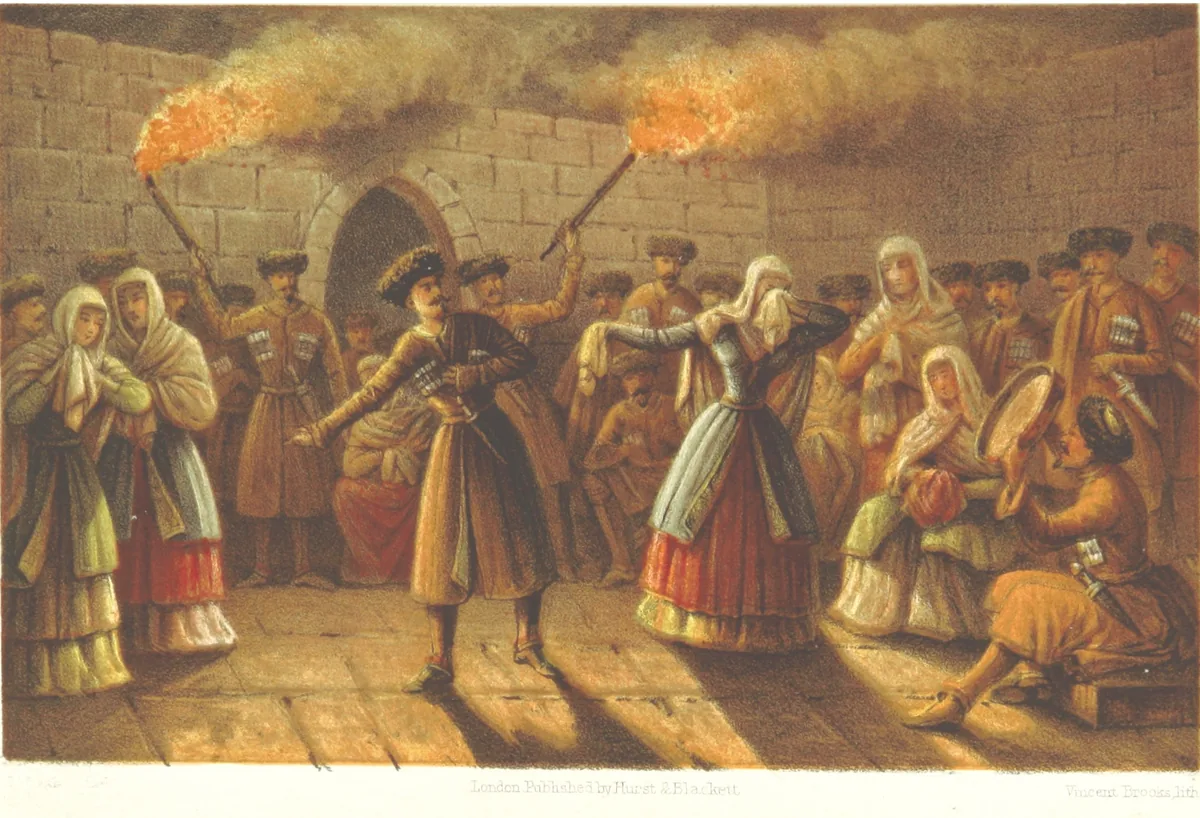
A Circassian wedding was also a джэгу, a word that means a game as well as a dance party. Riders competed in games on horseback. In one, riders from the bride’s side snatched the hat off any guest who was not paying attention, and the hat stayed with whoever took it unless its owner could win it back. In another, the пыIэеуэ, riders shot at a hat to show off their aim and horsemanship.
The dancing was led in the past by the джэгуакIуэ, a travelling performer who, in the dictionary’s words, played the dance master, the jester, the improvising singer and the musician all at once. And there were wedding songs, хьэгъуэлIыгъуэ уэрэд. For the dances themselves, read the guide to Circassian dance.
After the wedding
The couple had their own room, the лэгъунэ, and the bride’s relatives came to see how it was furnished. The bride brought gifts from her parents’ home, the пхъуантэдэлъ, literally “what lies in the chest”, and gave presents to her husband’s family, the нысэтын. When she first sat down to sew in her new home, a sweet dish of flour, butter and sugar was made in her honour, the мастэхьэлыуэ.
A new bride, a нысэ, kept a respectful distance from her husband’s family. In the past she did not say the names of her husband, his parents or his brothers, and called her husband’s brother by another name, usually an affectionate one. By custom there was a small symbolic payment when her husband’s parents first met her, so that she would begin to speak to them. Her first visit back to her own parents had its own name, the пэшэж. In noble families a companion, the жэмхэгъасэ, stayed with the bride for months as a helper and adviser until she settled in.
Not every marriage began with matchmakers. The dictionary also records elopement: a кIуасэ is a girl who marries without her parents’ knowledge.
The Circassian app has four short Habze lessons on marriage and the wedding, and courses in Kabardian and Adyghe to learn the words you hear at one.
Wedding words in Kabardian and Adyghe
The customs above are Kabardian. Here are a few of the words in both dialects:
| Meaning | Kabardian | Adyghe |
|---|---|---|
| wedding | хьэгъуэлIыгъуэ | нысэщэ джэгу |
| groom | псэлъыхъу | псэлъыхъу |
| matchmaker | лIыкIуэ | лIыкIо |
| dance, party, game | джэгу | джэгу |
| guest | хьэщIэh'eshch'e | хьакIэhak'e |
Free on iPhone & Android
Learn the language of the wedding
Short lessons in Kabardian or Adyghe, Habze lessons on Circassian traditions, and Circassians to meet from all over the world.

4.9 on the App Store 53,000+ people in 100+ countries
Circassian weddings: frequently asked questions
What is a Circassian wedding called?
In Kabardian a wedding is хьэгъуэлIыгъуэ, and the bringing of the bride to the groom’s home is нысашэ. In Adyghe a wedding is нысэщэ джэгу.
Why is the groom absent from a Circassian wedding?
By old Kabardian custom the groom stayed at the house of a relative or friend until the wedding was over, and was brought home at the end in a rite called щауэишыж.
What does псэлъыхъу mean?
псэлъыхъу is the Kabardian and Adyghe word for a groom; the Kabardian dictionary explains it as literally “one who seeks a soul”.
What is the hat game at Circassian weddings?
Riders from the bride’s side snatched the hat off a guest who was not paying attention, and the hat stayed with whoever took it unless its owner won it back.
Who lifts the bride’s veil?
During the wedding rite a man called the щхьэтех lifted the bride’s veil, the щхьэтепхъуэ.
Did Circassians pay a bride price?
In the past the groom’s side paid a bride price, уасэ, a word that now simply means “price”. There were also small symbolic payments, such as the куэбжэдэнэ for taking the bride out through the gate.
Sources
- M.L. Apazhev, Dzh.N. Kokov, Kabardino-cherkessko-russky slovar (Kabardino-Cherkess–Russian Dictionary, about 27,000 words), ed. B.Ch. Bizhoev, Nalchik: Elbrus, 2008. The wedding entries on pp. 73, 81, 86, 93, 112, 149, 182, 191, 213, 221, 236, 291, 311, 312, 316, 338, 341, 342, 354, 357, 364, 376, 379, 386, 387, 428, 443, 453, 534, 580, 581, 582, 594 and 655.
- Adyghe dictionary, dovlet.info: нысэщэ джэгу, псэлъыхъу, лIыкIо, джэгу. “Guest” in both dialects: the Circassian app’s lessons.
Want more like this?
The app has 64 short lessons on Circassian traditions, including four on weddings. Plus a course in Kabardian or Adyghe to learn the language behind them.
Download free53,000+ people in 100+ countries
