Kabardian, called Adyghebze (Адыгэбзэ) by its speakers, is the eastern branch of the Circassian language. It is official in Kabardino-Balkaria and Karachay-Cherkessia, in Russia’s North Caucasus, and most of its speakers today live in the Circassian diaspora, in Türkiye, Jordan, Syria and beyond. Kabardian is on neither Duolingo nor Google Translate, so many people assume it cannot be learned alone. It can: what you need is a clear plan and a way to hear every word.
Below are seven steps to learn Kabardian on your own, from the first letter to the first conversation. Each step says how the free Circassian App helps: it has 119 Kabardian lessons, and the first one is at the top of this page.
Can you learn Kabardian on your own?
Yes, if you have four things. Sound: Kabardian cannot be learned from letters alone. A habit: 15 to 20 minutes every day beats three hours once a week. Review: words have to come back before you forget them. And people: a language comes alive only when you answer in it. All of this used to mean piecing together old textbooks, PDFs and videos. Now it fits in one app.


Screenshots from the App Store listing.
Kabardian is famous for its sounds: 47 or 48 consonants and only three vowels, according to Wikipedia. It is also written in Cyrillic, which is one more thing to learn if you only read Latin letters. Both are easier by ear than on paper, which is why every word in the lessons can be played and every letter that has a sound can be heard.
Step 1. The Kabardian alphabet and its sounds
Kabardian uses the Cyrillic alphabet plus combinations for the sounds Russian does not have. Some are two letters, some three or even four: Къ, Хъ, Лъ, Гъу, Кхъу. The app teaches 60 letters and combinations in 15 short lessons.
The most important new sign is the palochka, I. After a consonant it makes the sound ejective, with a short “pop” in the throat, so К and КI are different sounds. On its own it is a glottal stop, a short catch in the throat. The app and this page write the palochka as a capital Latin I, which is easy to type on any keyboard.
The sounds English does not have: tap to hear them
Lesson “The Modifiers”
Lesson “Ejectives I”
Lesson “Ejectives II”
Lesson “Uvular Sounds”
Lesson “Soft & Complex”
Lesson “Labialized I”
Lesson “Labialized II”
Show the other 33 letters
Lesson “Vowels I”
Lesson “Vowels II”
Lesson “Simple Consonants I”
Lesson “Simple Consonants II”
Lesson “Simple Consonants III”
Lesson “Simple Consonants IV”
Lesson “Hissing Sounds”
Lesson “Affricates & Russian Letters”
Letters, sounds and lesson order from the app's alphabet course. Every letter with a sound is a native speaker's recording: tap to hear it.
Under each letter is a word from the Kabardian lessons, with the lesson’s own translation. At two alphabet lessons a day, the whole alphabet takes about a week. Every letter is explained in the Circassian alphabet: all 60 letters.
Step 2. Your first Kabardian words and phrases
Start with small dialogues you can use today, not with word lists. The first lesson of the course works that way: “Hello! How are you? Good. And you? I am well.” Here are the phrases of the first lessons, with the app’s audio:
| English | Kabardian |
|---|---|
| hello | ФIэхъус |
| how are you | Дауэ ущыт? |
| good | фIыщ |
| and you? | Уэ щэ? |
| I am well | Сыузыншэщ |
| thank you | Упсэу |
| goodbye | ФIыкIэ |
| please | кхъыIэ |
| I understand | КъызгурыIуэ |
| I don't understand | КъызгурыIуэркъым |
| My name is... | Сэ сыцIэр... |
| What is your name? | Хэт уэ уи цIэр? |
| I am Circassian | Сыадыгэщ |
Words, translations and audio from the app’s lessons “Basic Greetings”, “Politeness”, “Pronouns & Identity” and “Language & Place”.
Many answers end in -щ: фIыщ, Сыузыншэщ, Сыадыгэщ. That is how Kabardian often marks a statement. And сы- at the start of Сыузыншэщ and Сыадыгэщ means “I”. One Kabardian word does the work of a whole English sentence. The lessons show patterns like these through examples, not tables of rules.
More phrases: how to say hello, thank you and happy birthday in Circassian and 50 essential Circassian words and phrases.
Step 3. A little every day, with review
A language sticks through many short sessions, not one long evening. The Kabardian course in the app is a path of 10 sections, from greetings to conversations about life, and its lessons are short: pick the translation, hear a word and find it, build a sentence.
Words you have learned come back in later lessons. A word you get wrong comes back sooner; one you keep getting right comes back less and less often, after 1, 2, 4, 8 and then 16 lessons. That is spaced repetition, the way words move into long-term memory. Mistakes cost a heart: you have five, one comes back every four hours, and replaying lessons you have finished costs none.
- 1Foundations15 lessonsHello! · About Me · Family · Numbers · Colors · Essentials
- 2My World18 lessonsFarm Animals · Wild Animals · Food · Drinks · Elements · Landscape · Around the House
- 3Actions & Time19 lessonsBasic Verbs · More Actions · Expressive Actions · Time · Seasons & Weather · Telling Time
- 4Describing the World12 lessonsAdjectives 1 · Adjectives 2 · Body Parts · Health · Emotions
- 5Daily Life13 lessonsClothing · Places · People & Roles · More Professions · Numbers 11-100
- 6Going Places13 lessonsGetting Around · Directions · At the Hotel · Countries & Origins · Months & Calendar
- 7Social Life11 lessonsAt the Restaurant · Shopping · Technology · Hobbies & Sports · Weather
- 8Deeper Conversations8 lessonsEmergencies · Daily Routine · Opinions & Feelings
- 9Circassian Heritage6 lessonsHeritage · Traditions · The Diaspora
- 10Grand Finale4 lessonsGrand Review
The first time you open the app, it asks how well you know the language. A short placement test of 5 questions can then start you further along the path, up to section 5, so you do not begin with “hello”.
Step 4. Learn by ear: the Kabardian audio course
Many people who grew up around Kabardian understand it but cannot answer. The audio course is built for that: a narrator tells you in English what to say, you answer out loud in the pause, then you hear the right answer in Kabardian. Familiar phrases come back until they feel natural.
There are 31 lessons, about 8.5 hours with the English narrator (Russian, Turkish and Arabic narrators too). It keeps playing in the background with the screen off, so it suits a commute or a walk. The first four lessons are free; the rest come with Premium.
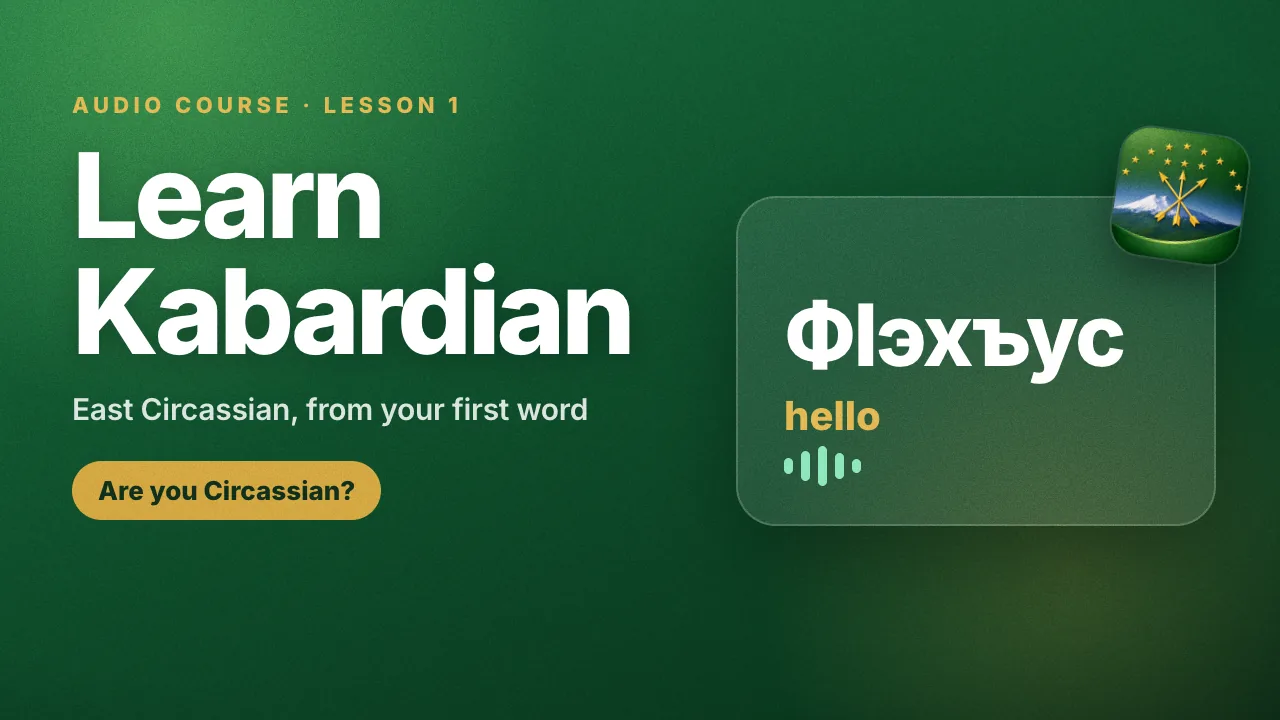
All 31 lessons of the Kabardian audio course
- 0How this course worksfree · 1 min
- 1Are you Circassian?free · 6 min
- 2Do you understand me?free · 12 min
- 3What's your name?free · 12 min
- 4Do you speak Circassian?12 min
- 5Where are you from?12 min
- 6I want, I don't want17 min
- 7Eating and drinking17 min
- 8Come here! This and that18 min
- 9Numbers 1 to 516 min
- 10Numbers 6 to 1016 min
- 11My family18 min
- 12House and garden18 min
- 13Where is it?19 min
- 14How old are you?19 min
- 15Who, what, why?19 min
- 16Good morning, good night18 min
- 17What time is it?20 min
- 18Making plans20 min
- 19Safe journey!18 min
- 20I have to go20 min
- 21How do you feel?19 min
- 22My head hurts17 min
- 23How much is it?18 min
- 24The past tense21 min
- 25Yesterday's story20 min
- 26Tomorrow I'll go19 min
- 27Today is cold19 min
- 28What do you like?18 min
- 29Welcome!16 min
- 30The whole story16 min
Step 5. Start speaking: a tutor and real people
To speak, you need someone to talk to, and the app has two kinds. The first is the AI tutor Сэтэней-гуащэ. She answers in Kabardian and can read her reply aloud. The translation is one tap away: it stays hidden at first, so you try the Kabardian before you peek. You can write to her any time and as clumsily as you like: she never gets tired and never laughs. The first 4 messages are free with a free account, then Premium.

The second kind is real. The Chat tab has the community’s General chat and a “Circassian Only” room, and the public chats have voice rooms. You can also make friends with Circassians from many countries and challenge them to duels on words and Habze.
Step 6. A dictionary and translator at hand
Found an unknown word in a family message? The app has a Kabardian dictionary of 24,190 entries, built from a printed Kabardian–Russian dictionary. Every entry has a Russian definition, and English searches go through an index built from those definitions. Word lookups work offline and without an account. On top of it, a translator handles whole sentences into and out of Kabardian by machine translation; that part needs a free account.
How to use both: the Circassian translator and dictionary.
Step 7. Language and culture: Adyghe Habze
Kabardian is hard to separate from Habze (also written Xabze), the Circassian code of honour and etiquette: how to receive a guest, how to speak to elders, how to behave at the table. The app has 16 Habze units of 4 lessons each: short cards with explanations, and situations where you choose what to do. They run in English, so you can learn the culture from day one, alongside the language.
- Core Values
- Hospitality
- Warrior Code
- Respect & Family
- Proverbs & Wisdom
- Nart Mythology
- Marriage & Wedding
- Music & Dance
- Traditional Dress
- Cuisine & Table
- Democratic Council
- Horse Culture
- Craftsmanship
- Nature & Sacred Places
- Circassian Tribes
- Festivals & Traditions
Kabardian or Adyghe: which one to learn?
Circassian has two literary forms. Kabardian, the eastern one, is spoken in Kabardino-Balkaria and Karachay-Cherkessia; Adyghe, the western one, in Adygea. They differ from the first lesson: greetings, many words, pronunciation.
Learn the one your family spoke. If you are not sure, ask your elders where the family comes from: Kabarda and Cherkessk mean Kabardian; Adygea, or Abzakh, Shapsug, Bzhedug and Hatuqay families, mean Adyghe. The app has both courses and never mixes them: choose East or West, and every word, sound and exercise will be in that one. You can switch at any time.
More: how Kabardian and Adyghe differ and learn Adyghe.
How long does it take to learn Kabardian?
There is no honest single number: it depends on how much you practise and whether you heard the language as a child. Here is a realistic plan at 15 to 20 minutes a day:
| When | What to do, 15 to 20 minutes a day |
|---|---|
| Week 1 | The 15 alphabet lessons and the first topics of “Foundations”: Hello!, About Me, Family. |
| Weeks 2–4 | The rest of “Foundations”: Numbers, Colors, Essentials. The free audio-course lessons 1 to 3. |
| Months 2–3 | The sections “My World” and “Actions & Time”. Your first messages to the tutor. |
| After that | About one section every two or three weeks. The “Circassian Only” chat and the voice rooms. |
Missed a day? Do not start over: the app remembers where you stopped and brings back the words that are due for review.
What is free, and what Premium adds
You can learn Kabardian in the app for free, with no time limit. Premium, optional, removes the limit on mistakes and opens everything else.
Free
- All 119 Kabardian lessons, in order
- The alphabet: 15 lessons, with every sound
- 64 Habze lessons
- The dictionary: 24,190 entries
- The first 4 audio-course lessons
- 4 messages to the AI tutor
- Chats, voice rooms and games
With Premium
- Unlimited hearts: mistakes never pause a lesson
- The full audio course: 31 lessons
- The tutor without limits
- Auto-translate in chats, and more
- A Family plan: one yearly plan for up to 6 people
New subscribers get 3 days free. Your app store shows the price in your currency.
What learners say
The app is rated 4.9 out of 5 from 285 ratings on the App Store. Reviews, word for word:
“I’m Circassian myself and even I learn something new every day. I like that apart from language learning, I can also learn about Circassian moral conduct and history. The app is perfectly designed, interface feels liquid to use and everything is quick and responsive. It’s a very good app for both beginners and advanced users, 100/10 ⭐️”
“It’s super interesting to learn about the Circassian culture. The language is incredibly difficult but the app makes it manageable. My favorite course is the Habze though! …”
“I'm a Circassian and I'm currently using this app to learn my mother language. It's amazing! It covers a wide range of topics and the terms are very accurate. Would highly recommend 👏👏”
“It’s an amazing app. Not only am I learning Circassian, but I’ve also met so many Circassian people through it.”
Free on iPhone and Android
Start learning Kabardian today
The alphabet, 119 lessons, the audio course, the dictionary and the tutor. The first lesson needs no account.

4.9 on the App Store 53,000+ people in 100+ countries
Questions about learning Kabardian
Can you learn Kabardian on your own?
Yes. You need four things: sound, a daily habit, review and people to talk to. The free Circassian App covers all four: 119 lessons with audio, spaced review, a dictionary, an audio course, an AI tutor and chats with Circassians around the world.
Where should a beginner start?
With the alphabet and its sounds. Kabardian is written in Cyrillic, and its extra sounds are spelled with letter combinations like Къ, Лъ and КI. Then the first phrases: ФIэхъус (hello), Упсэу (thank you), ФIыкIэ (goodbye).
Is Kabardian the same as Circassian?
Kabardian is one of the two literary forms of Circassian: East Circassian. The other is Adyghe, West Circassian. Kabardian is official in Kabardino-Balkaria and Karachay-Cherkessia, where it is also called the Cherkess language. The app teaches both, as separate courses.
Is Kabardian hard to learn?
The sounds are the hard part: Kabardian has 47 or 48 consonants and only three vowels. Words carry a lot, too: Сыадыгэщ alone means “I am Circassian”. Short lessons with audio spread the hard parts over weeks, and every letter with a sound can be heard.
What alphabet does Kabardian use?
Cyrillic, with extra letter combinations and the palochka, I. The app teaches it as 60 letters and combinations in 15 lessons, and every one of them except Ъ and Ь has a sound you can play.
Is there a Kabardian dictionary in English?
The app has a Kabardian dictionary of 24,190 entries from a printed Kabardian–Russian dictionary. Every entry has a Russian definition, and you can search it in English too. Word lookups work offline and without an account.
Can I learn Kabardian for free?
Yes. All 119 lessons of the course, the alphabet, the Habze units, the dictionary and the first 4 audio-course lessons are free. Premium, optional, removes the limit on mistakes and opens the full audio course and the tutor without limits.
Is the Kabardian spoken in Türkiye and Jordan the same as in Nalchik?
It is the same language. Diaspora families may use some different words and pronunciation, but speakers understand each other. The app teaches written Kabardian in Cyrillic.
Is Kabardian on Duolingo?
No. Duolingo has no Kabardian or Adyghe course, and Google Translate supports neither. The Circassian App offers the same kind of short lessons with audio and review, for both.
Does the app work offline?
The lessons, the alphabet, the word audio and the dictionary work offline. The chats and the tutor need a connection.
Sources
- Lessons, phrases, alphabet, Habze units, audio course, tutor and limits: the Circassian App’s own data (version 5.8), checked October 5, 2026.
- The app’s Kabardian dictionary: 24,190 entries, from a scanned printed Kabardian–Russian dictionary.
- Kabardian language, Wikipedia: official status, where it is spoken, the speaker estimate (Ethnologue, 2020), consonants and vowels, UNESCO’s classification. Read October 5, 2026.
- Duolingo’s course list and Google Translate’s language list, checked October 5, 2026.
- Rating: App Store, 285 ratings, average 4.94, October 5, 2026. Reviews from the App Store and Google Play, quoted word for word; a cut is marked “…”.
