Pick one of the two forms of Circassian, Kabardian or Adyghe, learn the alphabet with sound, then build vocabulary a few minutes every day with audio. Listen to real speech, learn Habze alongside the language, and practise with people. It takes time, but it is very possible in 2026: here is a plan in seven steps.
- 1Choose your dialect
- 2Learn the alphabet
- 3Build core vocabulary
- 4Listen to native speakers
- 5Learn Habze alongside
- 6Practice with people
- 7Be patient
Maybe your family is Circassian and you want to reconnect with your roots. Maybe a grandparent speaks Kabardian and you want to understand them, or you simply got curious about the Adyghe people. Learning Circassian is harder than learning Spanish or French: there are fewer resources, fewer people to practise with, and many unfamiliar sounds. But it is very possible, and there are more tools now than ever before.
Step 1: Choose your dialect
Circassian has two literary forms, and they differ from the very first lesson. Learn one first:
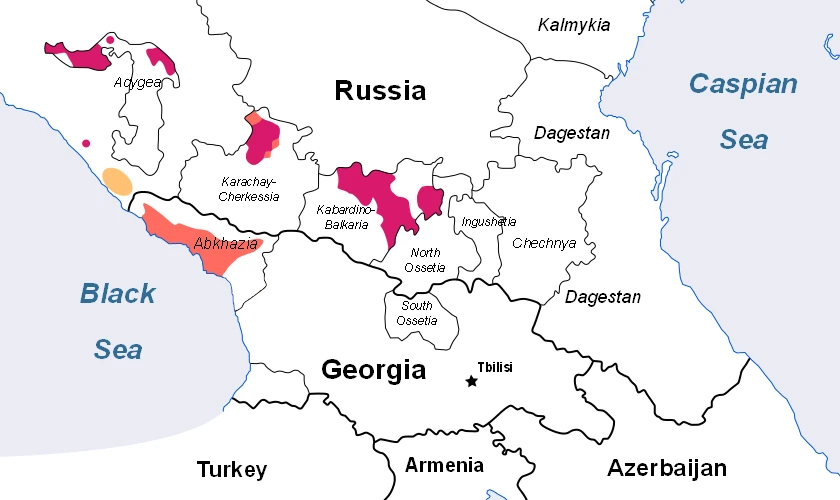
- Kabardian (East Circassian): about 1.9 million speakers, most of them in Kabardino-Balkaria and Karachay-Cherkessia.
- Adyghe (West Circassian): about 600,000 speakers, one of the two official languages of Adygea, and the language of much of the diaspora in Turkey, Jordan, Syria and Israel.
If your family is Kabardian, learn Kabardian. If your roots are in Adygea, or your family is Shapsug, Abzakh, Bzhedug or Hatuqay, learn Adyghe. With no family connection, either works. More in Kabardian vs Adyghe: what is the difference?
Step 2: Learn the alphabet
Circassian is written in Cyrillic with extra letters. If you read Russian you have a big head start; if not, learn the Cyrillic base first. Then focus on the new letters: the palochka (Ӏ) and combinations like Гъ, Къ, Хъ and Кхъ. Many of these sounds do not exist in English, Russian or Turkish, so your ears need training: listen to every letter, many times.
In the Circassian App the Kabardian alphabet (60 letters) takes 15 short lessons and the Adyghe alphabet (66 letters) 11, and every letter that has a sound is a native speaker’s recording. You can hear all of them in the Circassian alphabet guide.
Step 3: Build core vocabulary
Start with the words you will use every day: greetings, family, numbers and basic nouns. Here are twelve, from the app’s lessons, in both dialects; tap to hear them:
| In English | Kabardian | Adyghe |
|---|---|---|
| 1hello | ФIэхъусF'eĥus | СэламSelam |
| 2good day | Уи махуэ фIыуэ | Уимафэ шIу! |
| 3thank you | УпсэуUpsew | ТхьауегъэпсэуThaweyeghepsey |
| 4mother | анэane | нанэnane |
| 5father | адэade | татэ |
| 6brother | къуэшqwesh | шыshə |
| 7water | псыpsy | псыpsə |
| 8food | шхынshkhyn | шхыныshkhənə |
| 9house | унэwune | унэwne |
| 10one | зыzy | зыzə |
| 11two | тIуt'u | тIуt'u |
| 12three | щыshchy | щыshchə |
Aim for 50 to 100 words before you try to build sentences: 50 essential Circassian words, the phrasebook and counting to 100 will get you there. Use spaced repetition, so the words you forget come back: the app’s course (119 lessons in each dialect) starts with greetings, every word has audio, and the words you get wrong come back in later lessons until they stick.
Step 4: Listen to native speakers
Immersion is harder with Circassian than with big languages, but not impossible. Songs, interviews and family conversations all train your ear, even when you understand little: the rhythm and the sounds come first. Start with Circassian songs and artists and Circassian music.
For learning by ear there is also the app’s audio course: 31 lessons in each dialect, narrated in English, Russian, Turkish or Arabic, where you answer out loud in the pauses. It keeps playing with the screen off, and the first four lessons are free.
Step 5: Learn Habze alongside the language
The Circassian language and Habze, the Circassian code of conduct, are bound together. Words like адыгагъэ (“Circassianness”), нэмыс (decency, honour, respect) and напэ (literally “face”, also conscience) carry more than a dictionary can say. Learning Habze gives the vocabulary context, and the context makes it stick. The app gives Habze 16 units and 64 lessons of its own, from hospitality to Nart mythology, weddings and traditional dress. More in Habze, the Circassian code.
Step 6: Practice with people
Find Circassians near you or online: cultural associations, community events, family. Speaking with people moves you faster than any book, and in a Circassian family even a few words in the language mean a lot. Inside the app there are community chats, voice rooms and two AI tutors to practise with: Сэтэней-гуащэ for Kabardian and Кызбеч for Adyghe. Read how Circassian families keep the language alive.
Step 7: Be patient
Circassian is genuinely hard. The consonants alone take months to hear and say well, and the grammar is unlike English, Russian or Turkish: like all Northwest Caucasian languages, Kabardian and Adyghe are ergative, with the verb at the end of the sentence. How long it takes depends on how much you practise and what you already know: if you grew up hearing the language you will move much faster than a complete beginner.
Every word counts. Greeting an elder in Kabardian or saying thank you in Adyghe already means something. Regular short practice, 10 to 20 minutes a day, beats occasional long sessions. Perfection is not the goal; taking part is.
UNESCO lists Circassian as a vulnerable language, and in the diaspora fewer children learn it at home. Every new learner helps keep it alive.
Resources for learning Circassian
- An app with audio and structured lessons is the most efficient start for an independent learner: the difference between К, КӀ, Къ and Кхъ is learned by hearing it, not by reading about it. See the best app to learn Circassian.
- Games for vocabulary: archery and sword duels, a horse race and word games, a few minutes at a time. Five Circassian games
- Free resources: Wikipedia in Adyghe and in Kabardian, Mozilla Common Voice and an 1854 Circassian dictionary, collected in Is Circassian on Duolingo?
- Everyday tools: hello in Circassian, the phrasebook, numbers and the Circassian translator and dictionary.
Free on iPhone & Android
Learn Circassian a few minutes a day
Short Kabardian or Adyghe lessons with audio, an alphabet course and an AI tutor. The first lessons work without an account.

4.9 on the App Store 53,000+ people in 100+ countries
How to learn Circassian: questions
Should I learn Kabardian or Adyghe?
Follow your family: Kabardian if your family is Kabardian, Adyghe if your roots are in Adygea or your family is Shapsug, Abzakh, Bzhedug or Hatuqay. Without a family connection either works; Kabardian has more speakers, Adyghe is widely spoken in the diaspora.
Is Circassian hard to learn?
Yes, harder than most European languages: it has many consonants that English, Russian and Turkish lack, and an unusual ergative grammar. With daily practice and audio it is very possible.
How long does it take to learn Circassian?
It depends on how much you practise and what you already know. Heritage learners who heard it growing up move much faster than complete beginners. Regular short practice works best.
Can I learn Circassian without knowing Russian?
Yes. Knowing Cyrillic helps with the alphabet, but the app works in English, Russian, Turkish or Arabic, and the alphabet has its own lessons.
Is there a free way to learn Circassian?
Yes. The Circassian App’s lessons, alphabet and Habze units are free; Wikipedia in Adyghe and Kabardian and Mozilla Common Voice are free too.
Can I learn Circassian on Duolingo?
No, Duolingo has no Circassian course. The Circassian App uses a similar format, with short lessons, audio and spaced repetition, for both Kabardian and Adyghe.
Sources
- Wikipedia (English), “Kabardian language”. en.wikipedia.org/wiki/Kabardian_language
- Wikipedia (English), “Adyghe language”. en.wikipedia.org/wiki/Adyghe_language
- Wikipedia (English), “Adyghe Khabze”. en.wikipedia.org/wiki/Adyghe_Khabze
- Words and audio: the Circassian App’s Kabardian and Adyghe lessons (as on the 50 words page). Habze words: Kabardino-Cherkess–Russian dictionary (Apazhev & Kokov, 2008), pp. 333 and 336.
- App facts (lessons, alphabet, audio course, tutors, games): the Circassian App, version 5.8, checked October 5, 2026.
Learn Circassian in a few minutes a day
Short lessons in Kabardian or Adyghe. Hear how the words sound, learn to read the alphabet, then practice with an AI tutor who replies in Circassian.
Download free53,000+ people in 100+ countries
