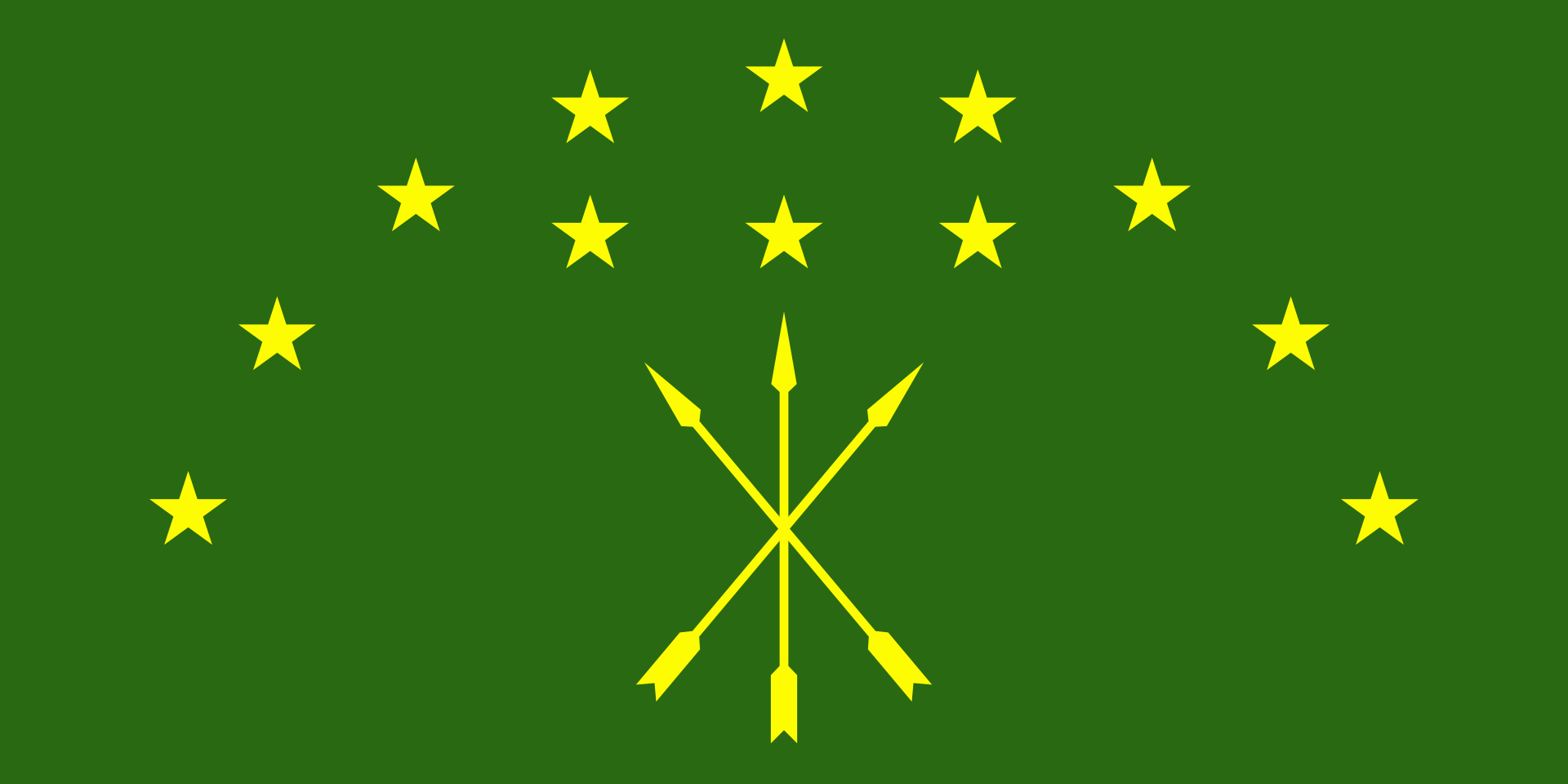
Circassians traditionally count twelve tribes, one for each gold star on the Circassian flag: the Abzakh, Besleney, Bzhedug, Hatuqay, Kabardians, Mamkhegh, Natukhai, Shapsug, Temirgoy, Ubykh, Yegeruqay and Zhaney. All call themselves Adyghe. The Kabardians are by far the largest; in the diaspora most Circassians are Kabardian, Abzakh or Shapsug.
Each tribe had its own lands, its own princes or assemblies and its own way of speaking, and many families still know which tribe they come from. Here is a map of the tribes’ lands in the early 19th century, the main tribes today, and which of the two written Circassian languages each one speaks.
On the map
The twelve tribes today
| Tribe | Own name | Language | Where today |
|---|---|---|---|
| Kabardians | Къэбэрдей | Kabardian (East) | Kabardino-Balkaria; Turkey (Uzunyayla), Jordan |
| Abzakh | Абдзах | Adyghe (West) | Turkey, Jordan, Syria, Israel; Hakurinohabl in Adygea |
| Shapsug | Шапсыгъ | Adyghe (West) | Tuapse and Sochi, Adygea; Turkey, Israel, Jordan |
| Bzhedug | Бжъэдыгъу | Adyghe (West) | Adygea (26 of its 48 Circassian villages), Krasnodar |
| Temirgoy | кӀэмгуй | Adyghe (West) | Eastern Adygea; Bilecik and Düzce in Turkey |
| Hatuqay | Хьатыкъуай | Adyghe (West) | Kayseri’s Pınarbaşı, Syria; Hatukay village in Adygea |
| Besleney | Беслъэней | Kabardian (East) | Karachay-Cherkessia, Adygea, Krasnodar Krai; Turkey |
| Natukhai | Натыхъуай | Adyghe (West) | Today almost only in the diaspora |
| Mamkhegh | Мэмхэгъ | Adyghe (West) | A small tribe, though a large clan |
| Yegeruqay | Еджэрыкъуай | Adyghe (West) | Today almost only in the diaspora |
| Zhaney | Жанэ | Adyghe (West) | No longer found as a tribe |
| Ubykh | Убых | Ubykh (extinct) | Almost only in Turkey; most speak Adyghe today |
The app’s tribe list also has the Makhosh, shown on the map, and the Abaza, a related people with a language of their own, close to Abkhaz.
Which course fits your tribe?
Kabardian (East Circassian) is the language of the Kabardians and the Besleney: learn Kabardian with the Circassian App.
Adyghe (West Circassian) is the language of all the other tribes, the Abzakh, Shapsug, Bzhedug, Temirgoy, Hatuqay, Natukhai, Mamkhegh, Yegeruqay and Zhaney, each with its own dialect: learn Adyghe with the Circassian App.
The Ubykh had a language of their own, which is no longer spoken; most Ubykh families speak Adyghe today. Read about the Ubykh language.
Both courses are in the same app, and you can switch between them at any time. The differences between the two are in Kabardian vs Adyghe.
Find people from your tribe
In the Circassian App you can add your family’s tribe to your profile, in the Origin field, and the Tribe filter in Search (free for everyone) shows people who chose the same tribe.
Questions
How many Circassian tribes are there?
Traditionally twelve, one for each star on the Circassian flag: Abzakh, Besleney, Bzhedug, Hatuqay, Kabardian, Mamkhegh, Natukhai, Shapsug, Temirgoy, Ubykh, Yegeruqay and Zhaney.
Which is the largest Circassian tribe?
The Kabardians, by far. In the diaspora most Circassians are Kabardian, Abzakh or Shapsug.
Which tribes speak Kabardian?
The Kabardians and the Besleney speak Kabardian (East Circassian); the other tribes speak dialects of Adyghe (West Circassian).
What are the three stars in a row on the flag?
In one reading, the three “democratic” tribes, the Natukhai, Shapsug and Abzakh, which were run by assemblies rather than princes; the nine stars in the arc are the aristocratic tribes.
Are the Abaza a Circassian tribe?
Not one of the twelve: the Abaza are a related people of the North-West Caucasus with a language of their own, closest to Abkhaz. Their culture and traditions are similar to those of the Circassians.
How can I find people from my tribe?
In the Circassian App: add your tribe in the Origin field of your profile and use the free Tribe filter in Search.
Free on iPhone & Android
Speak the language of your tribe
Kabardian or Adyghe lessons with audio, a Habze course, and people from your tribe to talk to.

4.9 on the App Store 50,000+ people in 100+ countries
Sources
- Wikipedia (English): Kabardians, revision 1375320450.
- Wikipedia (Russian): Кабардинцы, revision 154327529.
- Wikipedia (Turkish): Kabardeyler, revision 37286609.
- Wikipedia (English): Abzakhs, revision 1375142988.
- Wikipedia (Russian): Абадзехи, revision 151123751.
- Wikipedia (Turkish): Abzahlar, revision 37208868.
- Wikipedia (English): Shapsugs, revision 1375319031.
- Wikipedia (Russian): Шапсуги, revision 150426459.
- Wikipedia (Turkish): Şapsığlar, revision 38202177.
- Wikipedia (English): Bzhedugs, revision 1373856092.
- Wikipedia (Russian): Бжедуги, revision 154588141.
- Wikipedia (Turkish): Bjeduğlar, revision 36706643.
- Wikipedia (English): Chemguys, revision 1377929305.
- Wikipedia (Russian): Темиргоевцы, revision 155270849.
- Wikipedia (Turkish): Çemguylar, revision 35963779.
- Wikipedia (English): Hatuqay, revision 1366887070.
- Wikipedia (Russian): Хатукайцы, revision 147827674.
- Wikipedia (Turkish): Hatukaylar, revision 37666182.
- Wikipedia (English): Besleney, revision 1371613154.
- Wikipedia (Russian): Бесленеевцы, revision 147826444.
- Wikipedia (Turkish): Besleneyler, revision 37873575.
- Circassian App: the tribe list of the profile’s Origin field (src/data/origins.ts) and the Search filters, October 2026.
- Map: Liptink0, “Blank locator map of Circassia 1820s”, Wikimedia Commons, CC0 (after S. Khotko, «Открытие Черкесии. Картографические источники XIV–XIX вв.»).
- The three “democratic” tribes and the twelve stars: English Wikipedia, “Circassians”, as on the site’s page on the Circassian flag.
- The Abaza: English Wikipedia, “Abazins”, revision 1375140196.
Meet Circassians from around the world
Chat with Circassians in Turkey, Jordan, Russia and beyond, and learn Kabardian or Adyghe together in short daily lessons.
Download free50,000+ people in 100+ countries
