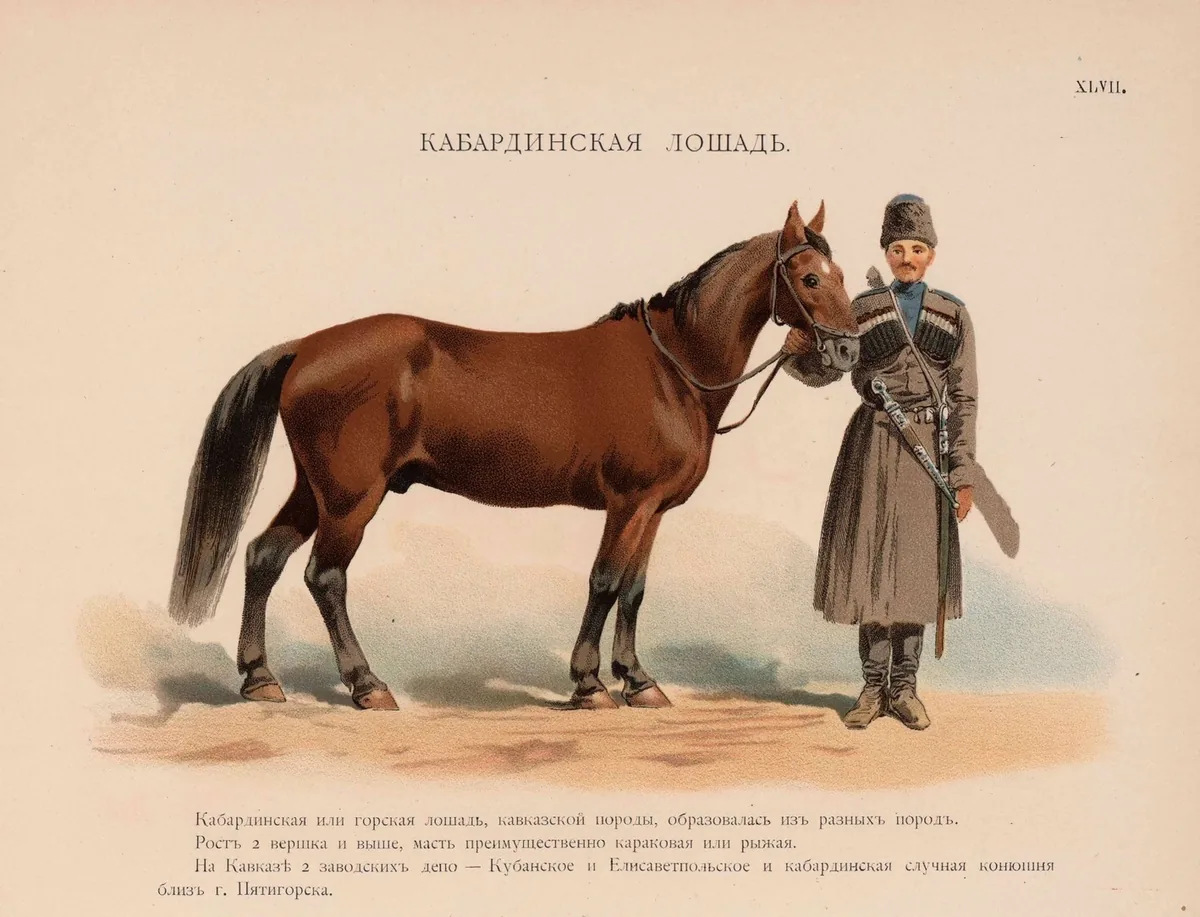
The Kabardian horse, or Kabarda horse, is one of the oldest horse breeds of the Caucasus, and one of the proudest parts of Circassian culture. Circassians, above all the Kabardians, bred it for centuries to carry a rider along stony mountain paths, over long distances, in any weather. In Kabardian and Adyghe the breed is called адыгэш, “Circassian horse”.
Here is where it comes from, what makes it a mountain horse, how travellers described Circassian horsemen, and how to say horse and rider in both dialects.
Where the Kabardian horse comes from
The Great Soviet Encyclopedia describes the Kabarda as one of the ancient riding and pack breeds, bred by Kabardians in the mountains of the North Caucasus from local mountain horses and steppe horses, later improved with Arabian and other eastern blood. By the 16th century it was already widespread. English sources add Karabakh and Turkoman horses to the mix and date the breed back at least 400 years.
The way it was kept shaped it just as much. Kabardian horses lived in herds all year, grazing on open mountain pastures in summer and in the foothills and plains in winter. Only the hardiest came through, and that toughness is still the breed’s calling card.
Why “Kabardian” and not “Circassian”? Horse breeding was most developed in Kabarda, the eastern Circassian lands, and the Russian name for the breed followed. In Circassian itself, the breed is simply адыгэш, the Circassian horse.
What makes it a mountain horse
Russia’s agricultural reference literature calls the Kabarda “the best mountain horse”, and its build explains why. It is medium-sized, with a deep chest, a short straight back, strong dry legs and very hard hooves, often with a slightly Roman-nosed head. Its blood carries oxygen well, which helps at altitude, and it keeps its footing on slippery, rocky slopes where other horses struggle.
Colours: the typical Kabardian horse is bay, often with a cherry tint, or dark bay; black is less common. Breeders describe three types: the basic mountain riding horse, a lighter “oriental” type with more Arabian influence, and a heavier “massive” type.
What it is not built for is short, flat-out speed. The breed shines on long rides and hard ground, which is why today it is mostly used for endurance riding, mountain trekking and leisure riding, and why it was crossed with Thoroughbreds to create the faster Anglo-Kabarda, recognized as a separate breed in 1966.
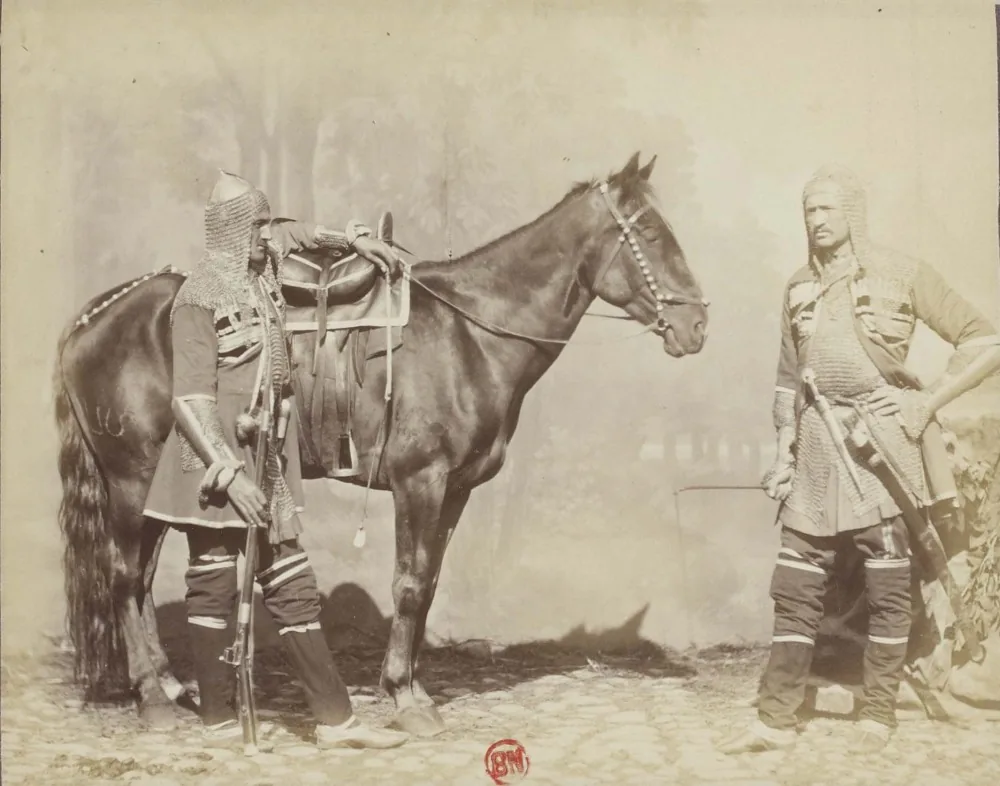
How Circassians rode: notes from old travellers
Nineteenth-century visitors to Circassia kept coming back to the bond between rider and horse. Their notes, and the horse lore recorded alongside them in the Russian Wikipedia article on the breed, share a few details:
- No horseshoes. Circassian horses were usually left unshod, and their hard hooves stood up to long, fast journeys anyway.
- A whip that cracks, not cuts. Riders used a thin whip ending in a flat leather flap, meant to startle the horse with a crack rather than to hurt it. Spurs were not used.
- Rest before food. After a long ride the horse stood saddled for a while before it was given hay.
- Favourite colour: bay. By Circassian tradition, bay horses were the most prized, and spotted ones were not ridden at all.
It fits a wider pattern in the Circassian warrior tradition, where the horse, the rider and his gear were one unit. Even Circassian names carry it: Shumaf means “happy horseman” (see Circassian boy names).
The Kabardian horse today
The breed came close to disappearing in the early 20th century and has been rebuilt since. The Great Soviet Encyclopedia names the Malka and Malokarachaevsky stud farms as the centres of breeding work, and the agricultural reference literature notes that the purebred population is small enough to need protection.
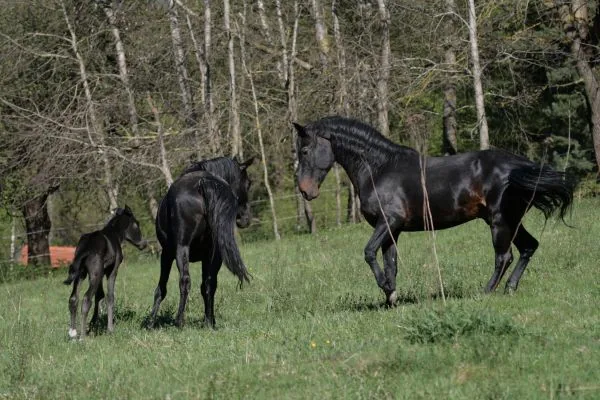
Outside Russia, Kabardian horses are kept in Europe and elsewhere, often as sport and endurance horses. And in Turkey, Circassians bred their own descendant of it: the Uzunyayla horse, a cross between the Kabarda and Hungarian horses.
Horse words in Kabardian and Adyghe
The word for horse is the same in both dialects, шы, and in Adyghe шы also means brother: the Adyghe lessons teach it both ways. Rider is where the dialects split. All of these come from the Circassian app’s lessons:
| English | Kabardian | Adyghe |
|---|---|---|
| horse | шыshy | шыshy |
| rider | шызехуэshyzekhue | шыузэтэсshyuzetes |
| horse riding | шыгъажэshyghazhe | шыгъачъэshyghache |
| English | Kabardian | Adyghe |
|---|---|---|
| fast horse | Шы псынщIэShy psynshch'e | – |
| I am on the horse | Шым сытесщShym sytesshch | – |
| I like horses | Шы сфIэфIщShy sf'ef'shch | – |
| one hundred horses | Щэ шыShche shy | – |
| The horse is big and fast. | – | Шыр ины ыкIи псынкIэ.Shyr iny yk'i psynk'e |
Ride it in the app: Horse Race
The Circassian app has a game built around exactly this horse. In Horse Race, the race’s eight words appear one by one in the paddock before the start, each with its sound. Then every question is a single tap: answer right and your horse surges ahead, and the faster you answer, the bigger the surge. A wrong answer makes it stumble.
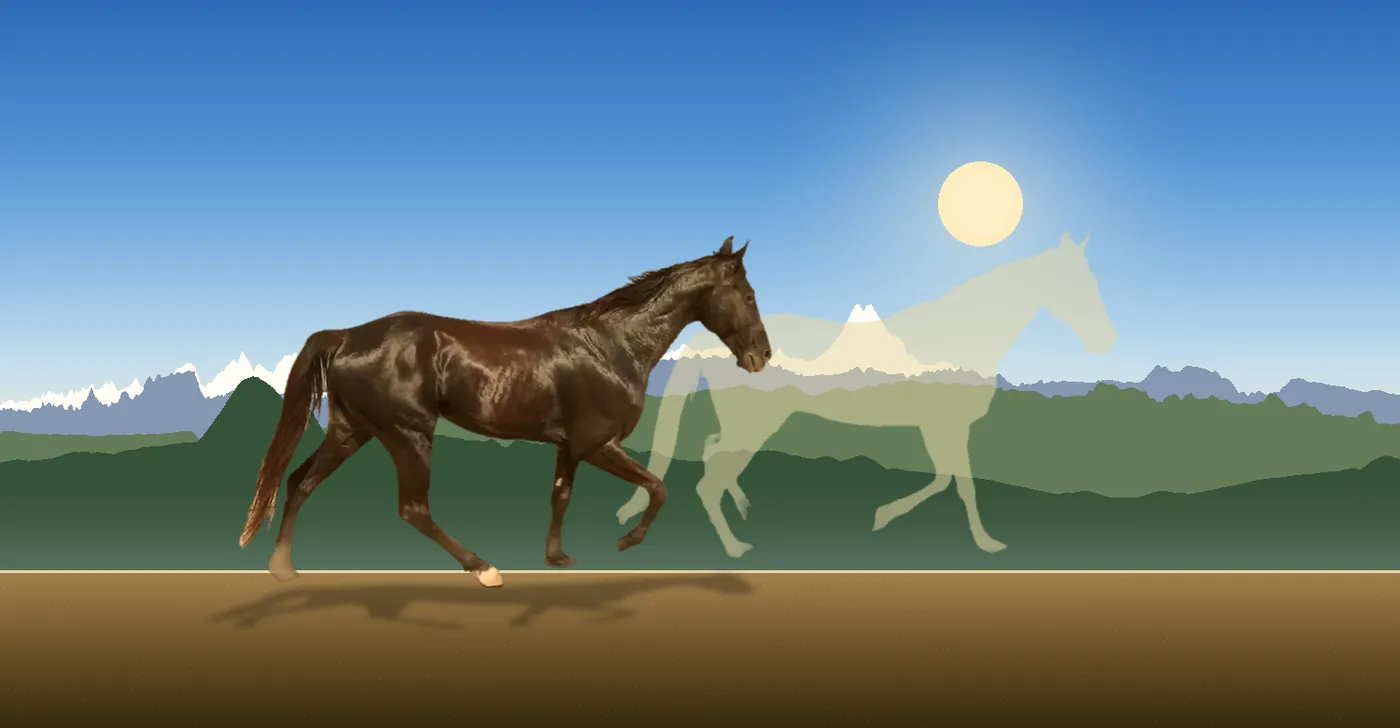
The words come from your own course, Kabardian or Adyghe, so every race is practice. More about all five games is in the best Circassian games.
Free on iPhone & Android
Race the Circassian horse
Download the Circassian app, pick Kabardian or Adyghe and run your first Horse Race today.

4.9 on the App Store 40,000+ people in 100+ countries
The Kabardian horse: frequently asked questions
What is the Kabardian horse?
The Kabardian or Kabarda horse is an old mountain breed from the North Caucasus, bred by Circassians, especially Kabardians, since at least the 16th century. It is known for endurance, hard hooves and sure footing on rocky ground.
Is the Kabardian horse a Circassian breed?
Yes. Kabardians are the eastern branch of the Circassians, and in Circassian the breed is called адыгэш, “Circassian horse”. The name Kabardian comes from Kabarda, where horse breeding was most developed.
What colour are Kabardian horses?
Most are bay, often with a cherry tint, or dark bay. Black is less common.
What is the Kabardian horse used for today?
Mostly endurance riding, mountain trekking and leisure riding. It was also crossed with Thoroughbreds to create the faster Anglo-Kabarda breed, recognized in 1966.
How do you say horse in Circassian?
Horse is шы in both Kabardian and Adyghe. Rider is шызехуэ in Kabardian and шыузэтэс in Adyghe.
What is the Uzunyayla horse?
A horse bred by Circassians in Turkey as a cross between the Kabarda horse and Hungarian horses.
Sources
- Great Soviet Encyclopedia, “Kabardinskaya poroda” (A.S. Krasnikov).
- Central Scientific Agricultural Library (CNSHB), reference entry “Kabardinskaya”.
- Wikipedia, “Kabarda horse”, and the Russian article “Kabardinskaya loshad” (travellers’ notes).
- Circassian app, Kabardian and Adyghe lessons (horse words and phrases) and the Horse Race game, version 5.2 (September 2026).
Play all five, free
Habze Duel, Archery Duel, Horse Race, Word Search and Word Rain. Every game practices what you learn in the app, from Kabardian or Adyghe words to Habze.
Download free40,000+ people in 100+ countries
