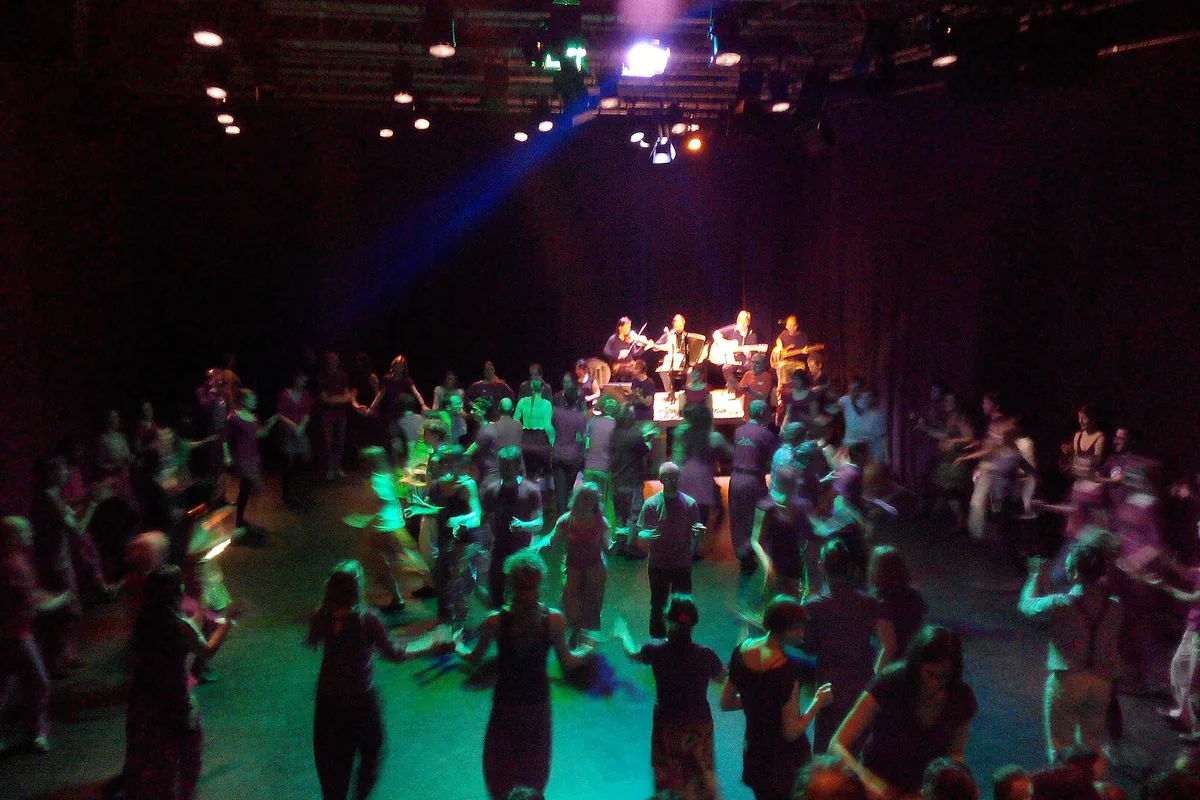
The Circassian Circle is a British social dance, not a Circassian one. It was created in London around 1820, and despite its name it has nothing to do with Circassia. Today it is usually danced as one big circle of couples, and it is a popular beginners’ dance at ceilidhs and balfolk evenings.
How to dance the Circassian Circle
The version danced most often today is the big circle. Everyone stands in one large circle facing the centre, each woman on her partner’s right. One common sequence, to 32 bars of a reel or jig:
- Bars 1–8. All walk four steps into the centre and four steps back, then repeat.
- Bars 9–16. The women go in with a clap and come back; then the men go in and come back, turning to face their partner.
- Bars 17–24. All swing their partner, ending side by side facing anticlockwise.
- Bars 25–32. All promenade anticlockwise around the circle, ready to form the big circle again.
There are many local variations. At balfolk dances it is done as a mixer, so partners change throughout the dance.
The Royal Scottish Country Dance Society published a different form in its Book 1 (1924): couples face couples around the room and dance right and left, set to partner twice and turn, a ladies’ chain, and a poussette that moves each couple on to the next.
Where it came from
The dance was invented around 1820 by a Mr Bemetzrieder of the King’s Theatre in London, according to a newspaper notice of 1824. The London dancing master G. M. S. Chivers taught it and included it in his book The Modern Dancing Master (1822), the first recorded mention of a dance called the Circassian Circle. It soon became more popular than Chivers’ own circle dances, judging by how often the English press mentioned it.
The early dance was anything but simple: by 1836 it had grown to six parts and 21 figures. Over the following decades it shrank, and by the 1900s it had one part of three or four figures. In 1928 the folk dance collector Maud Karpeles recorded two versions at Netherwitton in Northumberland: one for couples facing couples, danced to the jig “Bonnie Dundee”, and a big circle danced to the jig “Irish Washerwoman”. That big circle is the dance known as the Circassian Circle today.
The name turns up in film music too: the composer Max Steiner wove an Irish tune called the “Circassian Circle” into his score for the 1935 film The Informer.
Why is it called “Circassian”?
In the 1810s and 1820s British dancing masters loved exotic names for new dance forms: there were “Spanish” dances, “Swedish” dances and “Mescolanzes”. As an article in the Thistle Club’s Scottish country dancing magazine put it, these were merely names, and the Circassian Circle has nothing whatever to do with Circassia.
Real Circassian dances
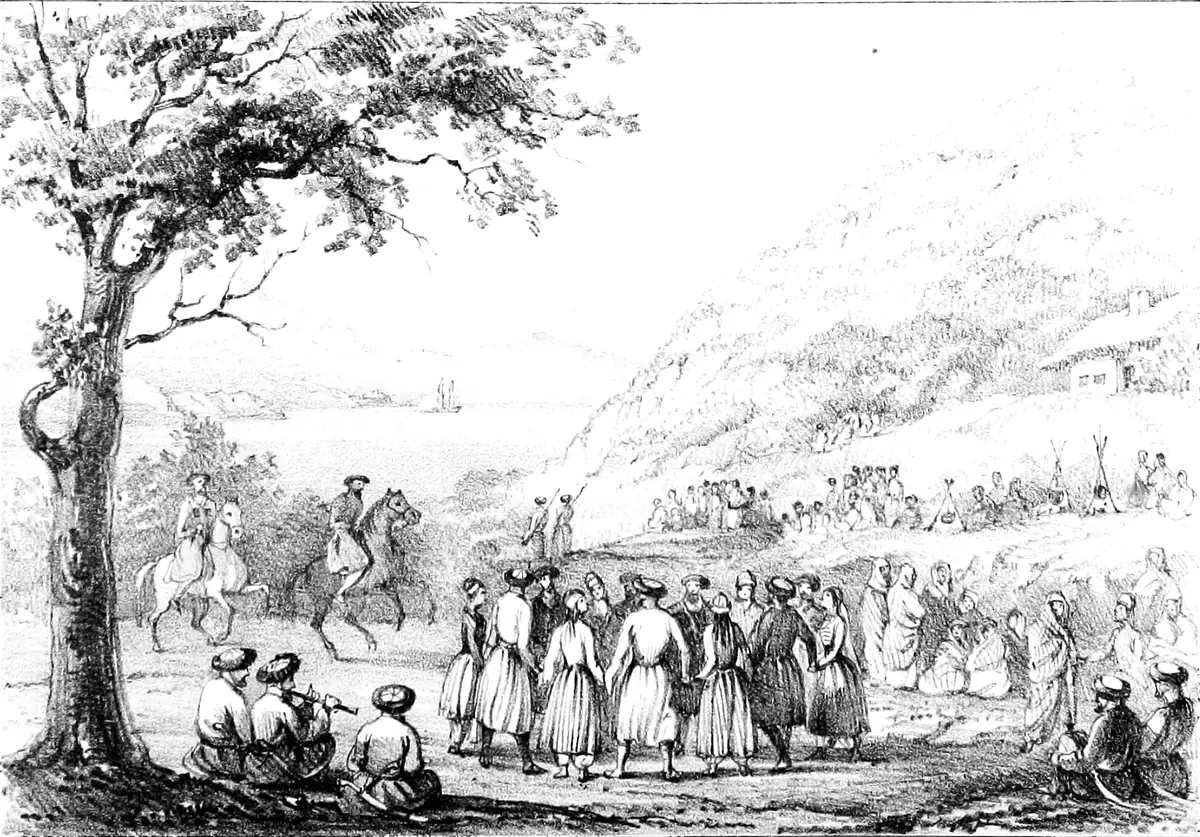
The Circassians have their own dances, such as the udzh, the qafa and the Islamey, in which men dance on the tips of their toes. They are performed at weddings and festivals from the Caucasus to Turkey, Jordan and America. Read our guide to Circassian dance to meet the real thing, or the stories behind the Nart sagas.
Free on iPhone & Android
Circassian language and culture, in one app
Kabardian and Adyghe lessons, Habze culture lessons, a library of books, films and music, and Circassians from around the world to talk to.

4.9 on the App Store 50,000+ people in 100+ countries
Circassian Circle: questions
Is the Circassian Circle a Circassian dance?
No. It is a British social dance created in London around 1820. Its name was a fashionable label of the time and has nothing to do with Circassia.
How do you dance the Circassian Circle?
In the usual big-circle version: into the centre and back twice; women in and out, then men in and out to face their partner; swing; promenade anticlockwise. It repeats every 32 bars, often with a change of partner.
What music is the Circassian Circle danced to?
Any 32-bar reel or jig. The big circle collected in Northumberland in 1928 was danced to the jig “Irish Washerwoman”.
Who invented the Circassian Circle?
A Mr Bemetzrieder of the King’s Theatre in London, around 1820. G. M. S. Chivers taught it and printed it in The Modern Dancing Master (1822).
What are real Circassian dances?
Dances such as the udzh, the Islamey and the qafa, danced at Circassian weddings and festivals around the world.
Sources
- RegencyDances.org, research paper on G.M.S. Chivers. www.regencydances.org/paper015.php
- Folkdance Footnotes, “Circassian Circle (L*) – Scotland” (after Ron Houston, Folk Dance Problem Solver, 2000). folkdancefootnotes.org/dance/a-real-folk-dance-what-is-it/about/circas
- The Thistle Club magazine, RSCDS London archive. www.rscdslondon.org.uk/_files/ugd/580b0a_6c9a3e4607df4219b4572250c825a
- Scottish Country Dancing Dictionary, “Circassian Circle”. www.scottish-country-dancing-dictionary.com/dance-crib/circassian-circ
- Scottish Country Dancing Dictionary, “Circassian (Big) Circle”. www.scottish-country-dancing-dictionary.com/dance-crib/circassian-big-
- Wikipedia, “Balfolk”. en.wikipedia.org/wiki/Balfolk
- Wikipedia, “Max Steiner”. en.wikipedia.org/wiki/Max_Steiner
Want more like this?
The app has 64 short lessons on Circassian culture and Habze, plus a course in Kabardian or Adyghe to learn the language behind them.
Download free50,000+ people in 100+ countries
